New Public Thinkers 2010

Fireworks-london-415x275

Blogosphere debates on ‘New UK Public Thinkers‘ inspired some deliberation over the holidays about both the nature of public thinking and those who have contributed in 2010. While considering my options I developed my own criteria. Significant public thinkers must be: 1) doing as well as thinking, 2) developing significant new ideas, and 3) participating in public debate. The criteria are perhaps as interesting as the nominations: what kind of thinking really matters? 

Continue reading

Climate or Cuts? The Same Problem!

Today in the House of Commons MPs vote for education cuts in the form of new £9000 a year tuition fees. Today in a courtroom in Nottingham the case against the climate activists who conspired to shut down Ratcliffe Power Station sums up and the jury retires to deliberate. What have they got in common?

These two events are part of the same problem. This is why: our economic system is structurally reliant on growth – and when growth hits geo-physical barriers, or social barriers, or cultural barriers it does whatever it has to do to abolish these barriers. Growth occurs through a process of turning our ecological, social and cultural space into economic space i.e. into commodities to be traded.  The economy needs to do this to grow, and it needs to grow to survive – so yes, as Thatcher might say, within the current set of conditions, ‘There Is No Alternative’ (TINA).  But there absolutely are alternatives to this way of organizing society. TINA serves elite interests and keeps us from demanding structural change.

Continue reading

Tim Jackson (Prosperity Without Growth) vs. Stoneleigh (The Automatic Earth)

Yesterday I had the opportunity to attend two events in one day presented by two significant economic analysts. Stoneleigh runs The Automatic Earth, now the 7th largest global website on finance, did a presentation in the afternoon at the new economics foundation. Later I attended a public debate – ‘Economic growth, prosperity and sustainability: a contradiction?’ in Westminster with Paul Ekins and Tim Jackson, hosted by the Sustainable Consumption Institute, University of Manchester.  I have a lot of respect for Tim Jackson, his analysis and the fact that he has been able to bring sensible and radical positions into government working with the now becoming defunct Sustainable Development Commission. Nevertheless, it does appear to me that the Stoneleigh has a more important story to tell at the moment.

Stoneleigh’s analysis is based the relationship between financial systems and energy systems. We are facing an economic contraction on a scale greater than that of the great depression. If those in charge of the economy had paid attention to the critiques of the economic model based on endless quantitative growth earlier, we might not be facing such a dire economic predictions. As it is, shifting policy to reflect geo-physical realities (such as the fact that the earth’s resources are finite and that climate change threatens civilization) would be smart, but it will not save us from more immediate dangers that will now be an inevitable consequence of the failure to manage financial sector responsibly combined with the failure to plan adequately for the advent of peak oil. 

Continue reading

Data, Information, Knowledge and Wisdom

I just posted a reply to David McCandless on his blog ‘Information is Beautiful’ on the subject of the difference between data, information, knowledge and wisdom. David made a graphic based on this heirarchy of information, and also helpfully pointed out that these ideas have been around for a while. Here is his graphic:
Data_info_knowledge_wisdom

I responded with some thoughts and an excerpt from Robert Logan, a Canadian physicist who has just written a book called ‘What is information?’ I have not actually read it yet but intend to soon (it is not yet available). Here is an excerpt from this book that breaks down these four categories: Continue reading

The Students are Revolting!

Img_0872

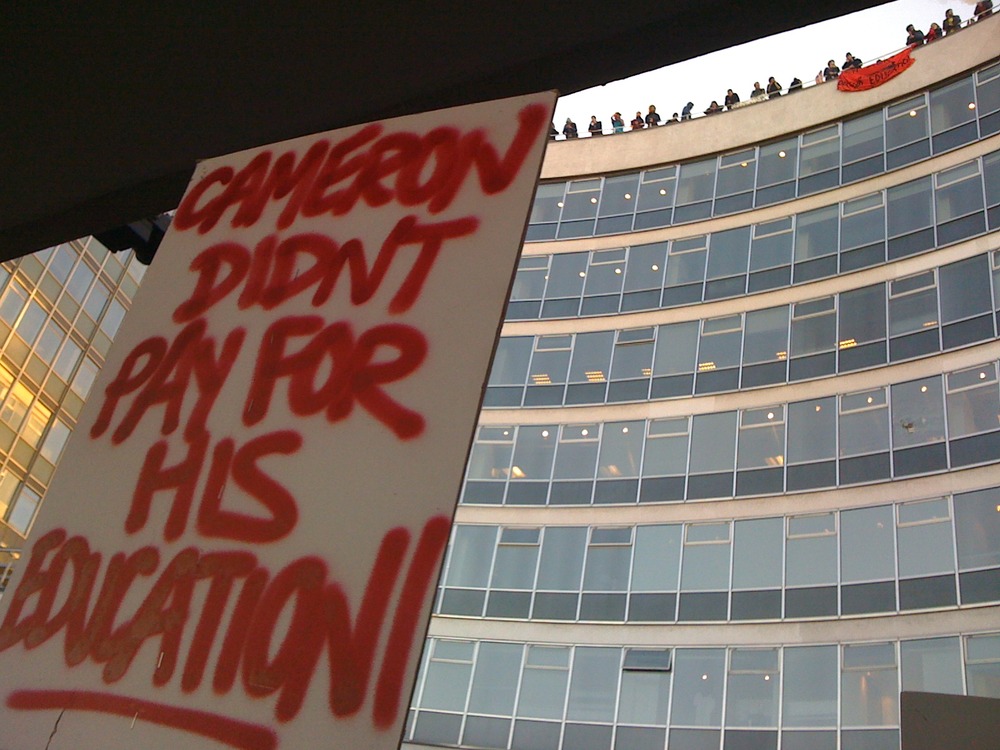
50,000 students took to the streets today to protest the dramatic cuts in higher education and increasing tuition fees. While most did not invade Tory HQ, several hundred stormed the towerblock in Millbank. These students did us all a service. The cuts to the public sector and education are an assault on the poor and middle classes in this country – as well as the environment. The student protesters are especially admirable as they will not likely to have to pay the increased fees, which come in after 2012 – it will be those who are slightly younger who will suffer. The financial industry must be held accountable for the financial and now the social crisis it created. Corporations must pay their taxes. Hopefully these young people will inspire others who are more directly effected by the cuts to stand up to this assault on public services and the environment.

Continue reading

The Environment is a Feminist Issue


Yellow3

Response to Channel 4


Last night’s ‘What the Green Movement Got Wrong’ documentary launched a Twitter storm of protests to the one-sided misinformation calculated to discredit traditional green values and political projects. The debate on Twitter was entertaining yet unfortunately most viewers will not have been sitting at their computers and will have been subjected less critically to the one-sided polemic that hit the airwaves. Towards the end of the two-part programme the dismal lack of female voices on the Channel Four documentary became apparent and a new sub-theme emerged on Twitter regarding the exclusion of women from the debate.


Channel Four editors claim they could not find any women and that those that they asked refused. I can certainly understand why a woman would refuse to allow herself to have her position misrepresented, ruthlessly discredited through biased, severely selective, and ill-informed journalism. If women environmentalists were enabled to make a document about ‘What the Green Movement Got Right’ we would have a fair platform. Unfortunately, what Channel Four wanted was a few environmentalists to argue their positions in a mosh-pit debate in a little post-documentary forum. By fabricating an illusion of fairness they attempt to escape properly presenting the green arguments. Although some debaters did an excellent job at debunking Channel Four’s corporate green spin – the show still managed to disseminate some deeply anti-green ideas as described by George Monbiot this morning in this blog post ‘Deep Peace in Techno-Utopia.’


The women vs. men issue is not about tick boxing. It is about presenting powerful and dominant political positions as the only perspective in town. It’s about recognizing that power inequalities exist due to historical exclusion of women’s voices from public debate. Ultimately, the environment is a feminist issue.

Continue reading

War Against Nature in an Age of Austerity

My October started with the ‘Science and Environment Communication’ section at ECREA (European Communications Research and Education Association) conference in Hamburg. Four days of research presentations mostly focused on our abysm failure to protect the ecological health of this planet and to communicate to the public the scope of the problem left me completely deflated. One possible good outcome could be the formation of an International Association of Environmental Communicators, which could function as a body to expose the avalanche of misinformation and deception practiced by corporate entities who have an interest in a certain mis-representation of nature.

Continue reading

Marginalized Design 4 Development at Tent

Img_0707

I visited the Kingston’s Design 4 Development MA show at Tent last week. The MA group have been investigating sustainability in design and development.  The stall showcased some projects and gave the opportunity to participate in a debate about sustainability. Someone wrote on the chalk board, ‘sustainability = efficiency.’ I wrote on the chalk board ‘not if you spend the money you save on an Easyjet flight to Spain.’ So goes the debate within the marginalised spaces occupied by designers interested in sustainability. Designers with faith in eco-efficiency vs those of us who see the need for structural change (and a good deal of eco-efficiency). Nonetheless, the bigger story is just how marginalized these visions for development are within the London design scene.

Tent_floorplan2010

Examine the context of small sustainable design hubs within the London Design scene at Tent gala exhibition. I am posting the map, with two small circles around the only stalls I discovered with credible aspirations at sustainability. The most important story coming from the exhibition is that sustainability is still marginal on the London design scene.

Continue reading

Oil Painting Protest over BP sponsorship in Tate Modern Turbine Hall

In what was perhaps the most politically charged artistic action ever to take place at the Tate Modern, yesterday a group of artists demonstrated against using public institutions to legitimize the business of fossil fuel industries such as BP. Should the Tate behave as a pawn to the highest bidder? Its ‘neutral’ stance conceals the privileges gained by those corporations with the cash to invest (no matter what kind of damage is done in the process of obtaining this cash). Our public institutions should not take money from the oil industry – just as they can no longer be funded by tobacco, these cosy alliances must come to an end.

Continue reading

Corporate Watch, The Finance Lab and Collapsonomics

Last week I attended three events focused on the exploring problems and possible solutions within the economic system. The first was hosted by Corporate Watch (at SOAS),  the second by WWF’s ‘Finance Lab‘ (at the Institute of Chartered Accountants), and the third a meet-up at the SouthBank by the Collapsonomics gang. Three events focused on big problems, all attempting to create the public discussions we desperately need to counter a system with a dangerous lack of resilience, skirting dangerously close to creating a prolonged depression – along with the disastrous consequences for the natural world caused by an economic system blind to the needs of ecological systems.

The role of the state in this mess is to make sure the crisis made by the financial sector is paid for by all of us. Nick Hillyard from The Corner House describes how this economic crisis is characterised by an absence of public debate on the source of the crises. No-one questions the need for government cuts in a system that seems to have spiralled out of our control; so the failure of the private sector (the banks) is being shifted onto the public sector (us). Austerity measures are only now starting to be put into effect. The fall out from the economic crisis is barely visible in wealthy parts of the UK, but will start to happen in a dramatic way when the cuts are made. What is important to remember is that austerity measures are not some kind of inevitable process because we had (& have) no alternative.  They are the result of government policy that has allowed the financial sector to operate in an relatively unregulated manner,  and policies which consistently put the interests of the corporations before the interests of the public or the planet.  None of this just happened – it happened due to specific policies and a certain economic agenda which allowed it to happen.

Continue reading

Why EcoMag Failed

Ecomag_no_copy

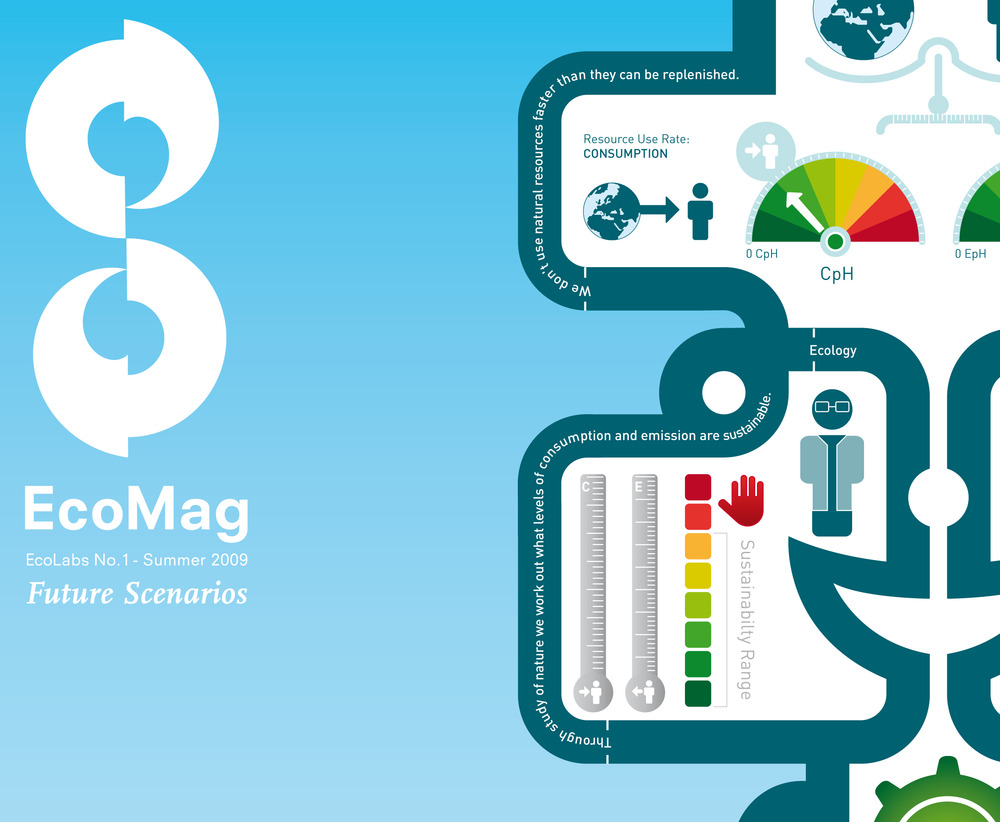
The first issue of EcoMag, Future Scenarios, is in boxes in my hallway. Our intention with EcoMag was to create a magazine that would help bring some discussions, ideas and information common amoungst environmentalists to wider audiences; and specifically those in the design and cultural industries in London. Unfortunately, although over the magazine pdf has been downloaded over 17,000 times on-line and the artwork is excellent (thanks to eight brilliant artists), the magazine itself did not make it financially viable to produce another issue. Our second issue was going to use the same technique of using artwork to map complex information visually. The theme of the second issue was going to create information design on the theme of ecological economics.

What went wrong with EcoMag? Well, EcoMag intended to reach unengaged audiences in the cultural sector. Could images convince them to become involved with the struggles to stop some of the threats depicted in the magazine? It is hard to analyze the impact of a series images. But in a culture that only values financially lucrative projects, EcoMag was an oddity and failed to find the support it needed. Yesterday a prominent designer interested in ‘sustainability’ explained to me that designers are now getting involved with ecological issues because they now see how it can be profitable. I think this man has seriously miscalculated both the severity of the problems we face in terms of climate change, resource depletion, soil erosion, bio-diversity loss, water scarcity, fish depletion, etc. etc.  and the capacity of the present system to pay people to fix these problems. More honestly, there is now a deeper recognizition of the crises, and the system had made some money avaliable for those who will make it appear like these problems are being addressed, as long as they do not question the deeper roots of the problems (thereby legitimizing the status quo).

Continue reading

It is still a Rich World

I lost another job today. The job, for an environmental agency communicating biodiversity, was ‘suspended’ due to slashed budgets. This kind of thing is happening all over the environmental and social sector as we start to feel the impact of austerity measures resulting from the enormous transfer of public wealth to private banks and corporations. I am not in the slightest bit convinced that we are not able to afford environmental and social programmes; yes, its true our governments are loaded with debt and the economy is in tatters, but this is still a rich country (and certain markets, such as the art market have remained buoyant).  Feigning poverty to avoid collective responsiblity is a cheap trick. I do not for a second believe that we do not have the money to protect biodiversity, provide ecological education, or stop climate change – but these programmes are all being slashed. It’s not that I lost a job, but it is that some vitally important work is not being done.