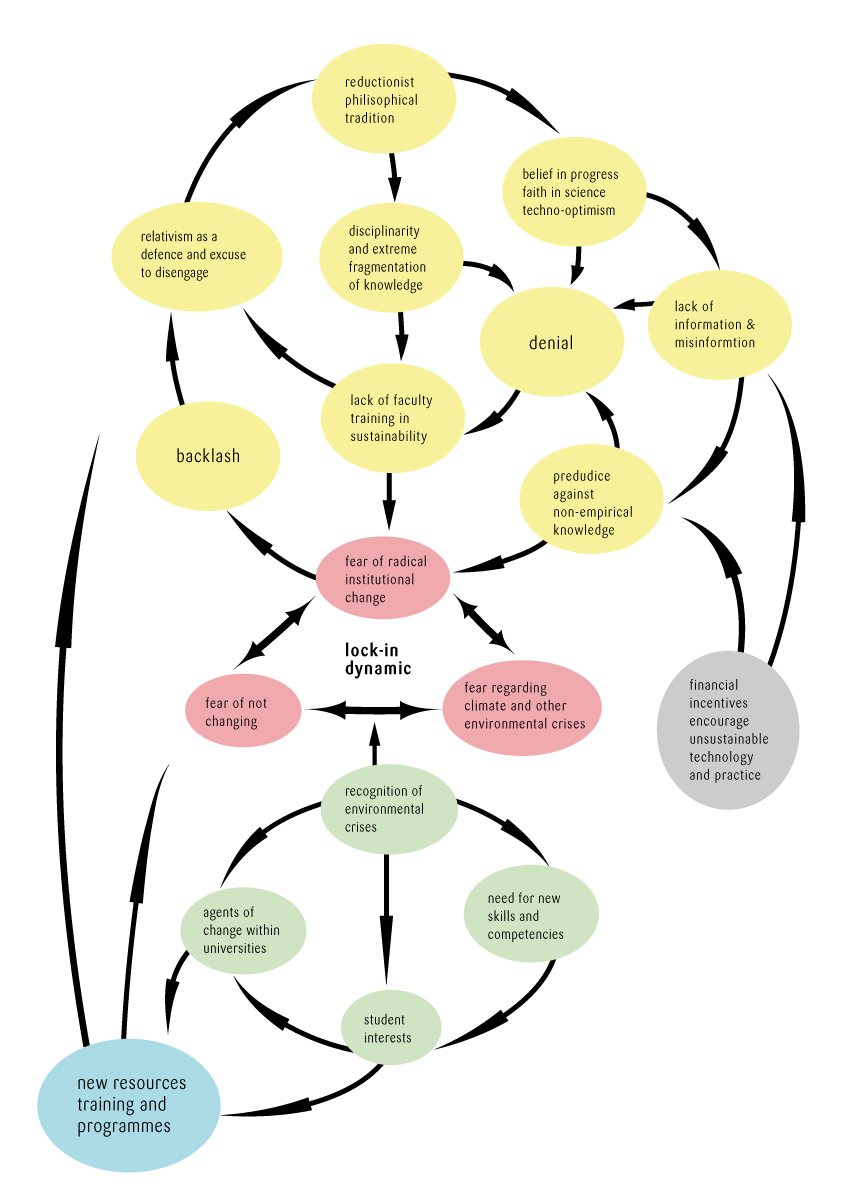
Basic sustainability literacy is an essential element of education. Without sustainability education, students are not supported to develop the knowledge that they will need to understand contemporary problems – or the skills they will need to address these problems. Considering global ecological conditions, it would be wise for higher education to create capacities across disciplines to respond to current problems. Unfortunately this is simply not happening on a significant scale (outside the disciplines that deal directly with the environment, i.e. conservation biology, the earth sciences and geography). Educational establishments create blind spots by failing to embed sustainability literacy in education. By not acknowledging environmental problems as an educational priority, higher education reproduces the problems of the past. Educators remain oblivious to the ways in which their own practices further perpetuate environmental problems.
In the natural sciences, scientists are deeply concerned (an understatement in many cases) about the dangers of de-stabilised ecological systems. It is the responsibility of universities to develop capacities to respond, but most of those developing curriculum in design education would rather ignore inconvenient environmental imperatives. While I appreciate the difficulty that higher education is under right now, these problems pale in significance in comparison to the dangers presented by environmental problems. In fact, it will be impossible to achieve economic prosperity in the future without greater concern for environmental issues.
Many educators think sustainability is already part of what they do. Yet environmental problems are a result of an entire way of approaching knowledge that is ecologically ill-informed. Ecological and systems literacies are not divinely anointed, they are learned – like any discipline. They require their own curriculum, classes, research and expertise in design education. It cannot be delivered in a ‘Green Week’ fashion. This is simply greenwash. Education that refuses to engage critically with environmental problems is part of the problem.
Sustainability literacy should be a required element of any university degree at this point, but especially design education (for reasons I describe in my PhD). Any university that is not doing this is derelict in their responsibility to equip students with the knowledge they will need to deal with the world they will inherit. I have set up two Linkedin groups to discuss these problems in higher education and a group for ecological literacy in design education.
Thanks for the inspiration here @blindspotting
 EcoLabs