The Visual Communication of the Environment in Theory and Practice: Nurturing Relational Perception

Image-makers have the unique ability to make currently invisible ecological processes and relationships visible. Within the context of an increasingly visual culture, images have potential to nurture the development of new perceptual capabilities and encourage relational perception. Graphic design is well suited to facilitate ecological learning since it can draw on a wide variety of visual strategies to display specific geographic spaces, ecological patterns and processes, abstract concepts and future scenarios. Julie Doyle argues that photography records circumstances of the past, so its usefulness in communicating ecological messages is limited to displaying damages already done (2009). My own work proposes that graphic design has greater potential to respond to environmental communication challenges due to its ability harness the communicative potential of maps, charts, diagrams, graphs, timelines, illustrations, network visualizations, data visualization, information graphics, controversy maps, giga-maps and systems oriented design to make complex information accessible, comprehensible and alluring. With design strategies, image-makers can reveal relationships, patterns and dynamics in complex systems. For these reasons, graphic design has exceptional potential to support relational perceptual practices and the ability to ‘see systems’ – nurturing both relational perception and ecological literacy.

For more information please see my Design Research Society 2014 conference paper. Download the paper here.
Mapping Climate Communication – slideshow for #COCE2015 and #UE2015

Mapping-Climate-Communication.-TIMELINE-15-OCT2014-web-sm

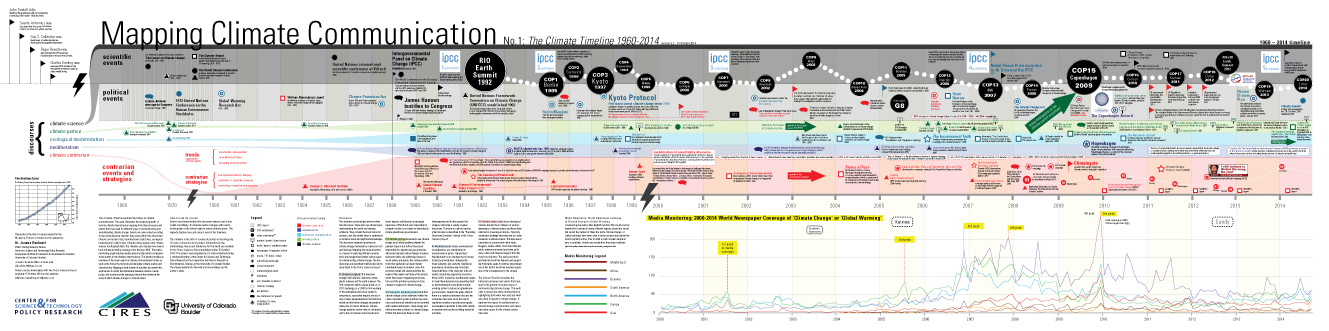
The Mapping Climate Communication project offers an overview of how climate change is communicated in the public realm by visualizing actors, events, strategies, media coverage and discourses influencing public opinion. Two large-scale maps and one Poster Summary Report were published on-line October 2014. The project uses two visualization methods: a timeline and a network visualization. The Climate Timeline (CT) visualizes the historical processes and events that have lead to the growth of various ways of communicating climate change. The Network of Actors (NoA) illustrates relationships between institutions, organizations and individuals participating in climate communication in Canada, United States and the United Kingdom. Together these two visualizations contextualize events and actors within five discourses: climate science, climate justice, ecological modernization, neoliberalism and climate contrarianism. Since communication happens at the level of rhetoric as well as the level of action, discourses in this project include explicit messages and also messages that are implicit within political, corporate and organizational activities and policy. This approach reveals tensions and contradictions in climate communication.

Workshop at #COCE2015 – The Visual Communication of the Environment in Theory and Practice: Nurturing Relational Perception

This Saturday 4pm workshop at The 2015 Conference on Communication and Environment in Boulder ‘Bridging Divides: Spaces of Scholarship and Practice in Environmental Communication’  will start with an illustrated theoretical introduction that will display and describe specific visual strategies to communicate environmental information. The session will be followed by an design critique. The design crit is a foundational practice in design education for developing creativity, visual literacy, communication expertise and design skills. It will provide a setting for evaluating and refining individual samples of visual communication design in response to the objectives of each particular piece of work. It will give participants an opportunity to discuss specific examples of visual communication on the environment. The examples for discussion can be submitted by email by anyone interested in participating in this workshop.

Workshop - June2015_Page_09

Image-makers have the unique ability to make invisible ecological processes and relationships visible, tangible and accessible. Within the context of an increasingly visual culture, images have potential to nurture the development of new perceptual capabilities and encourage relational perception. Graphic design is well suited to facilitate environmental learning since it can draw on a wide variety of visual strategies to display specific geographic spaces, ecological processes, abstract concepts and future scenarios. With design strategies, image-makers can reveal relationships, patterns and dynamics in complex systems. For these reasons, graphic design has exceptional potential to support relational perceptual practices and ecological literacy.

Workshop - June2015_Page_32

More information on this workshop can be found here.