Ecological Literacy in Design Education: A Foundation for Sustainable Design

drscumoslo

The paper ‘Ecological Literacy in Design Education: A Foundation for Sustainable Design’ has been accepted for the Design Research Society  // CUMULUS 2013 2nd International Conference for Design Education Researchers in May 2013. This paper is available for here for free but it will only be published and presented at the conference proceedings if I am able to find sponsors. THANK YOU to everyone who helped raise the money for this presentation! The crowdfunding campaign worked and I will present this paper in Oslo next month.

Ecological Literacy in Design Education: A Foundation for Sustainable Design

Abstract: Responsible design in an era of scarcity and risk associated with environmental problems must be ecologically informed. Ecological literacy is necessary in order to both understand the nature of environmental problems and to respond effectively by designing sustainable ways of living. Embedding ecological literacy into design education is happening at the most progressive institutions – and yet for many others, sustainability education is still virtually absent from the curriculum. Progress is slow despite the fact that natural scientists warn that risks will escalate if we do not take dramatic action. Ecological literacy is a severe challenge as it disrupts educational cultures and challenges basic assumptions about what constitutes good design. While sustainability can seem profoundly difficult, ecological learning is the basis for sustainable design and thus it is a basic imperative in design education. Design education needs to expand its scope of inquiry to include a range of disciplines in order to address complex environmental problems. This paper will present an introduction to ecological literacy for design education, describe six ecological principles including associated concepts in systems design, and explain why critical thinking is necessary to make the work of transforming structurally unsustainable systems possible.

Keywords: sustainability, philosophy, design education, knowledge, ecological literacy, epistemology, philosophy of design education, multidisciplinary design education

The paper can now be downloaded from the EcoLabs website here.

The slideshow of the presentation can be accessed here.Nature-Patterns2012M


BIG THANKS to everyone who made it happen by supporting the crowdfunding compaign. On Twitter you are: @Ian_Willey @blindspotting @hugh_knowles @karinjaschke @sDesignLabs @paul_chandlerUK @sorafferty and @jenboehnert. Some of you are not on Twitter (as far as I can tell) and you are Richard Owen Frost, Prof. Gregory Stock, Jonathan Crinion, Joel Davis, Ali Hodgson, Chris Kitchen and a few Anonymous contributors.

Design Culture Salon 3 – Design Activism: how does it change things?

guyjulier's avatarDesign Culture Salon

Tuesday 26 February 1900h-2030h
Hochhauser Auditorium, Sackler Centre, V&A

Panelists:
Jody Boehnert (EcoLabs)
Jonathan Chapman (University of Brighton)
Noel Douglas (Occupy Design)
Paul Micklethwaite (Kingston University)

Climate change, resource scarcity, economic crisis and struggles for social justice have given rise to new movements in design that seek more than creative and commercial fulfilment. What models of design practice support this? How might design work with other activist practices? What role do universities and museums have? How can design activism work with marginality?

Free, but booking is essential:: http://www.vam.ac.uk/whatson/event/1971/date/20130226/

The Panel

Jody Boehnert is an environmental communicator, designer, educator and activist who lives in Brixton. She is founding director of EcoLabs (http://eco-labs.org)
– a non-profit studio visualising complex environmental issues and recently completed an Arts and Humanities Research Council funded PhD titled: ‘The Visual Communication of Ecological Literacy: Design, Learning and Emergent Ecological Perception’ at the University of Brighton…

View original post 421 more words

A Critical Look at RSA and TSB’s ‘New Designs for A Circular Economy’

In the UK social institutions maintain their legitimacy with claims that they are responding the environmental crisis with initiatives capable of transforming our economy into something that could exist in perpetuity. The single most important factor in the continued failure of the vast majority of initiatives is the dismal lack of ecological awareness demonstrated by those who put these projects into practice. A technologically advanced civilization that is not ecologically informed simply has no long-term prospects; it will not even understand the ways in which it is destroying itself. Businesses are keen to project the image that they are working towards a circular economy and dramatically lowering both pollution and quantitaties of natural resources needed in the industrial cycle. Are these flashy claims an honest representation of progress, or simply a new front for business as usual?

Re-thinking Progress: The Circular Economy by made2bemadeagain – The Ellen MacArthur Foundation

Continue reading

Denial in Environmental Communication

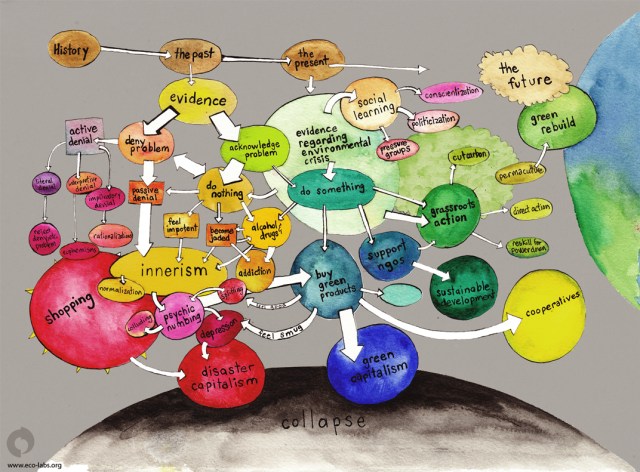
People tend to deny information that they find uncomfortable. In the seminal book States of Denial sociologist Stanley Cohen states that a proclivity to deny disturbing facts is the normal state of affairs for people in an information-saturated society. Cohen’s book is based on wide-reaching cross-cultural studies including Nazi Germany, South Africa, Israel/Palestine, Rwanda and others zones of human rights abuse, genocide and state sanctioned or institutional violence. Cohen describes strategies of denial on a personal level as psychological and cognitive, and on societal level as communicative and political. Denial can function psychologically below levels of awareness; denial is a ‘high speed cognitive mechanism for processing information, like the computer command to delete rather than save’ (Cohen 2001:5). On a cultural level, communication breakdown works to support denial. Relativism reinforces denial strategies in popular culture and in political debate. In its most extreme form, relativism makes all value systems equal, even those responsible for human suffering and the destruction of the natural world. In this way, relativism is corrosive to moral action.
responses---EcoLabs---sm

Although Cohen’s analysis of how disturbing information is avoided is based on violence against people, this work on denial is relevant for environmental communications as first suggested by climate communicator George Marshall (2007, 2009) and further developed in this thesis. Understanding the psychological and communicative processes at work inform strategies to break denial in order to facilitate acknowledgement of environmental crisis – the essential first step towards transformation. This chapter will examine how environmental communication can break the numbing effects of denial of ecological self through a greater understanding of associated psychological and social processes.

Denial is complex and multi-faceted and a primary communicative obstacle in environmental communication. Cohen describes the psychological and cognitive processes supporting denial in individuals. The ability to block out, remain passive, apathetic, indifferent and unresponsive is, an unconscious defence mechanism for coping with guilt, anxiety or other disturbing emotions aroused by guilt. The psyche blocks off information that is literally unthinkable or unbearable. The unconscious sets up a barrier that prevents the thought from reaching conscious knowledge (Ibid:5).

According to Cohen, denial manifests in three different ways (although each of these has endless characteristics):

1) Literal (nothing happened)
2) Interpretative (what happened is really something else)
3) Implicatory (what happened was justified) (Cohen 2001:99)

Each of these strategies for denial must be circumvented with care. These types of denial are further complicated by levels at which they become evident within individuals:

1) Cognition (not acknowledging the facts)
2) Emotion (not feeling, not being disturbed)
3) Morality (not recognizing wrongness or responsibility)
4) Action (not taking steps in response to knowledge) (Ibid:9)

Each of these states of denial is also a stage towards acknowledgement as part of a strategy to break denial. The processes that occur in individuals are multiplied across cultural groups where denial becomes institutionalized and systemic (Ibid:94).

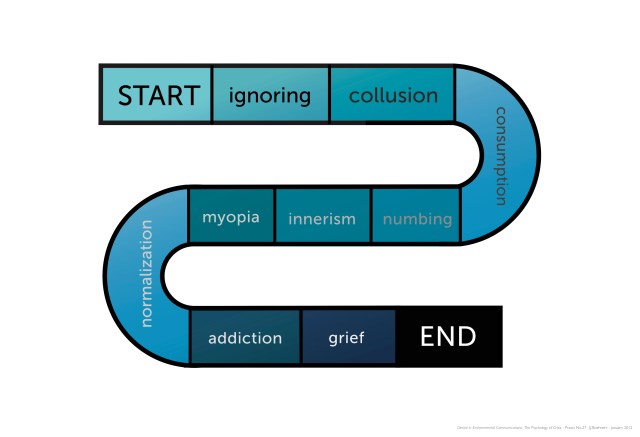
Denial in social groups is exacerbated by communication failure and by powerful interests that benefit from keeping denial working in their favour. On a cultural level, multiple individual cases of denial leads to normalization, then ignoring which develops into collusion: ‘People trying to look innocent by not noticing’ (Ibid:xii). Here cultures of ‘splitting’ develop characterized by dissociation and psychic numbing (Ibid:93). Cohen describes how cultures plagued by high levels of denial escape into a state that he calls ‘innerism’, defined as an ‘escape from the public sphere into private life and consumer interests’ (Ibid:156). The spectacles of consumer capitalism clearly provide sufficient distractions.

Cohen’s work on denial has useful insights for the communication of ecological literacy. Collective acknowledgement must become an explicit goal. Cohen explains that ‘acknowledgement is what happens to knowledge when it becomes officially sanctioned and enters public discourse’ (Ibid:225). Collective acknowledgement is transformational as it ‘makes previously normalized conditions into social problems… [and]…social institutions, policy strategies, and, even a new language are in place to undermine denial and encourage and channel individual acknowledgement’ (Ibid:250). This dramatic change comes about through the work of social movements and public discourses that aim to chip away and eventually shatter denial. Strategies for breaking denial involve creating the individual and social capacity for acceptance of circumstances. Social movements use processes of consciousness-raising or politicization to effect this change (Ibid:11). Tactics for breaking denial aim beyond merely presenting the facts and invoking moral arguments to directly addressing the social and psychological mechanisms that support denial.
denial in EC no.1 - outlines copy

Learning to accept denial as a natural phenomenon and not demonize those who perpetuate denial (despite the destructive consequences that are a result of the lack of political will and motivation for change) must be a foundational concept for effective environmental communication. Understanding the psychological processes of denial can help communicators assist individuals through the difficult process of acknowledging and reacting to disturbing environmental information. Getting to the point where denial is acknowledged and actively addressed is key. Cohen explains:

Instead of agonizing about why denial occurs, we should take this state for granted. The theoretical question is not ‘why do we shut out?’ but ‘what do we ever not shut out?’ The empirical problem is not uncover yet ever more evidence of denial, but to discover the conditions under which information is acknowledged and acted upon. The political problem is how to create these conditions. This reframes the classic studies of obedience: instead of asking why most people obey authority so unthinkingly, let us look again and again at the consistent minority – nearly on-third, after all – who refuse to obey (Ibid:249).

Communication strategies can be designed to turn denial into a category of social deviance. For example, drawing analogies from the feminist struggle, compare the social acceptability of misogyny in 1950 versus 2011. Environmental communicators must work to make denial of ecological conscience as socially unacceptable as misogyny.1 Pressure groups and social movements work on shattering denial to end the normalization of ignoring and help create collective acknowledgement. Cohen’s work is based on denial of human rights abuses rather the harm humanity perpetuates on the natural world but the lessons learned from these struggles can inform an understanding of denial of ecological relations. History has witnessed radical social change in the past where new moral codes were created and we have consciously changed power dynamics, laws and institutions accordingly (obvious examples are the civil rights, feminist and anti-colonization movements). Similar strategies are now needed to encounter denial of ecological relations in order to move to acknowledgement and action.

This text is re-published (slightly edited) from my 2012 PhD ‘The Visual Communication of Ecological Literacy: Designing, Learning and Emergent Ecological Perception‘, which is available here.

Sustainability Literacy in Higher Education

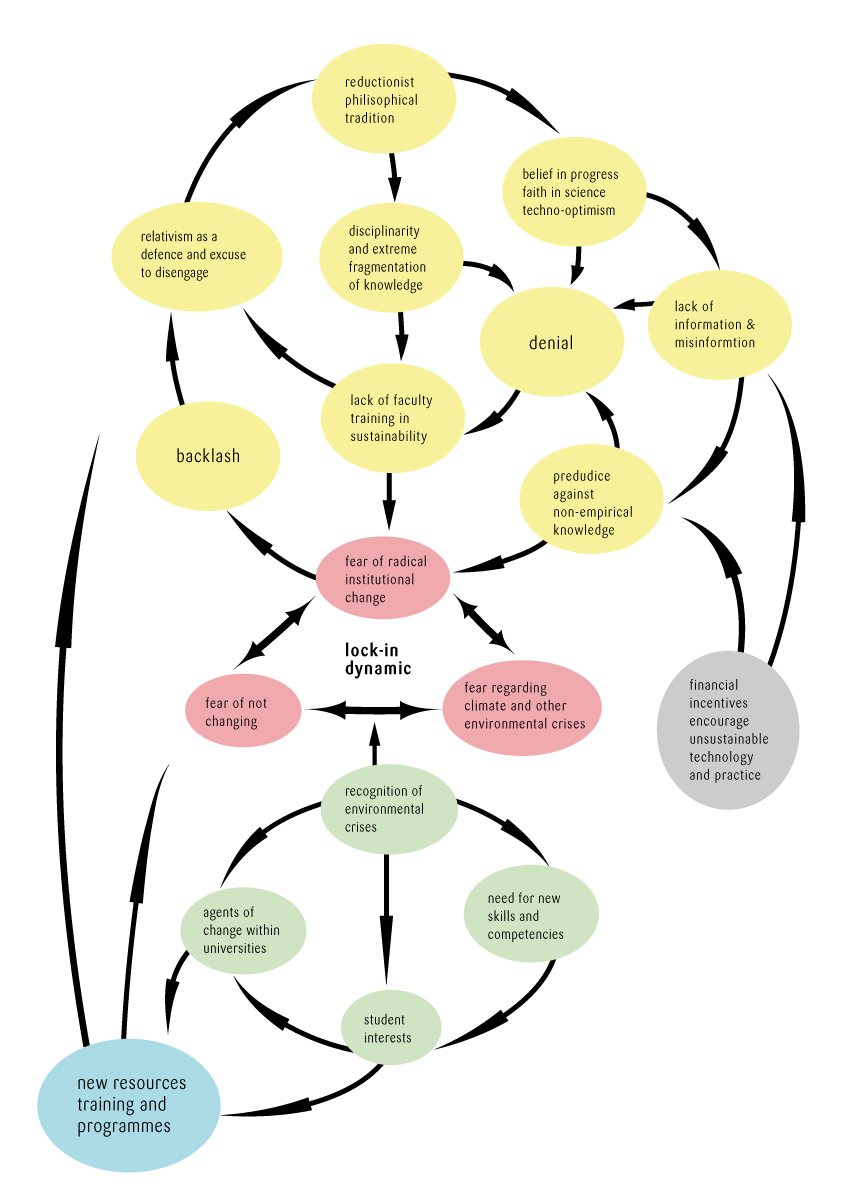
EL-in-HEI-LOCK-IN-2012

Basic sustainability literacy is an essential element of education. Without sustainability education, students are not supported to develop the knowledge that they will need to understand contemporary problems – or the skills they will need to address these problems. Considering global ecological conditions, it would be wise for higher education to create capacities across disciplines to respond to current problems. Unfortunately this is simply not happening on a significant scale (outside the disciplines that deal directly with the environment, i.e. conservation biology, the earth sciences and geography). Educational establishments create blind spots by failing to embed sustainability literacy in education. By not acknowledging environmental problems as an educational priority, higher education reproduces the problems of the past.  Educators remain oblivious to the ways in which their own practices further perpetuate environmental problems.

In the natural sciences, scientists are deeply concerned (an understatement in many cases) about the dangers of de-stabilised ecological systems. It is the responsibility of universities to develop capacities to respond, but most of those developing curriculum in design education would rather ignore inconvenient environmental imperatives. While I appreciate the difficulty that higher education is under right now, these problems pale in significance in comparison to the dangers presented by environmental problems. In fact, it will be impossible to achieve economic prosperity in the future without greater concern for environmental issues.

Many educators think sustainability is already part of what they do. Yet environmental problems are a result of an entire way of approaching knowledge that is ecologically ill-informed. Ecological and systems literacies are not divinely anointed, they are learned – like any discipline. They require their own curriculum, classes, research and expertise in design education. It cannot be delivered in a ‘Green Week’ fashion. This is simply greenwash. Education that refuses to engage critically with environmental problems is part of the problem.

Sustainability literacy should be a required element of any university degree at this point, but especially design education (for reasons I describe in my PhD). Any university that is not doing this is derelict in their responsibility to equip students with the knowledge they will need to deal with the world they will inherit. I have set up two Linkedin groups to discuss these problems in higher education  and a group for ecological literacy in design education.

Thanks for the inspiration here @blindspotting

2012: ‘The World is Not Ending. It is the Opposite’

Over the holidays I have read the latest Club of Rome report Bankrupting Nature. I did this not because I enjoy reading non-fiction over Christmas but because I am grateful for the time I have to celebrate and I am compelled to consider how others will be able to do the same considering the deterioration of global ecological systems.

Soul_network_new_years_eve_party_london_17

Two things became apparent: 1) the extinction crises is accelerating, 2) we have more knowledge and understanding than ever to address ecological and social crises. That second point was the good news. The bad news is that I can say with some confidence, as someone who works in London at the interface of environmental communication, ecological informed design and sustainability education, that we are simply not making the ecological crises a priority. Instead of using the wealth that is still abundant in this country to address environmental problems – we are squandering the opportunities we now have to catalyze transformation.

London-bridge

With severe ecological destabilization, possibilities for future prosperity disappear. Yet in education and economic policy, the basic fact that we depend on the stability and abundance of the Earth is largely ignored. We are simply not building the social institutions that would enable social transformation. Part of the problem rests with the educational establishment; ecologically literacy is still marginal in higher education. For this reason, the capacity to understand, much less respond to current problems is extraordinarily low. This blog will review the state of our capacities for cultural transformation in the UK at the end of 2012 by looking (very briefly) at social institutions and social movements. I will start by proposing that we take note of the words of the Mayan people.

In 2012 we survived the final of all the anticipated ‘end of the worlds’ and the media typically simultaneously mocked and commercialized what became the spectacle of the end of Mayan Long Count calendar, the 5,125-year cycle that ended on 21 December 2012. A film called  ‘2012 The Mayan Word’ documented the voices of the Mayan people who had some potent things to say:

“The world is not ending. It is the opposite: we are finishing ourselves off…The prophecies are given for us to check ourselves. What are we doing? It’s clear that if we don’t do anything to recover the equilibrium of Mother Earth, we are digging our own grave” (Maria Amalia Mex Tu’n, 26 mins). Continue reading