Flows of Money Into and Out of Low and Middle Income Countries

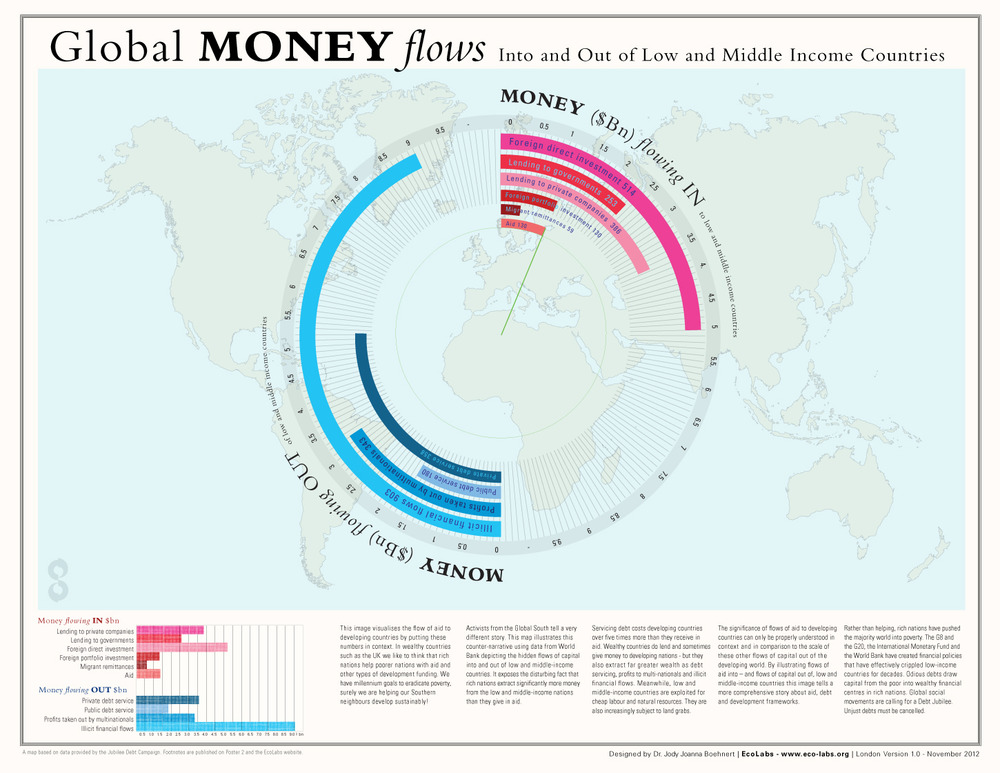
In wealthy countries such as the UK we like to think that rich nations help poorer nations with aid and other types of development funding. We have millennium goals to eradicate poverty, surely we are helping our Southern neighbours develop sustainably?

Money-flows-ecolabs

Activists from the Global South tell a very different story. This map illustrates this counter-narrative using data from World Bank depicting the hidden flows of capital into and out of low and middle-income countries. It exposes the disturbing fact that rich nations extract significantly more money from the low and middle-income nations than they give in aid. Continue reading

Visualising the Economic System – and Alternatives

Over the past six months I have been helping Occupy Design UK explore how design can be used to facilitate popular education on the structural causes of the recent economic crisis. During the London Design Festival we held an event at the V&A called ‘Exposing the 1% and De-branding the City’ where we examined information graphics and animations that illustrate the complexity of our economic system and exactly what went so wrong in the recent credit crisis. The following visualisations expose the dynamics and structural problems within the current economic system and propose what we can do to create a more resilient system for long-term prosperity, social justice and sustainability.

Crises of Capitalism. RSA Animate. Cognitive Media.

This animation features Marxist historian David Harvey’s analysis of the structural causes of the economic crisis and the role of crisis in the history of capitalism. Here animation studio Cognitive Media use the Monopoly metaphor that the Occupy Movement has also repeatedly used to describe the systemic dynamics of capitalism (another example can be found below). This video presents an overview of the contradictions of the capitalism system. While the Royal Society of Arts funded this animation, Harvey’s interpretation of the causes economic crisis remains marginal in mainstream economic discourse. The Occupy Movement has successfully created at least some discursive space in mainstream media for radical critiques such as this one.

Capitalism_as_pyramid

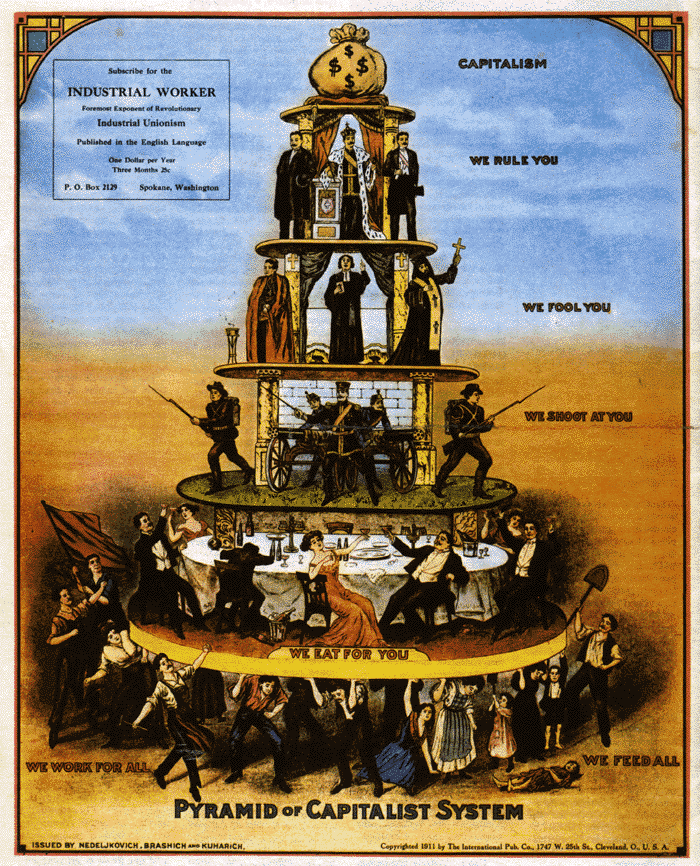
Capitalism is a Pyramid Scheme

CrimethInc. Workers’ Collective and Packard Jennings. Pdf back of poster.

Pyramid_of_capitalist_system

The poster included with the CrimethInc. Workers’ Collective book ‘Work’ is based on a classic illustration Continue reading

Strategies of Denial of Ecological Self

Ecopsychology_fix4_-_sm

This week I am finally publishing Chapter Nine of my PhD: ‘Communication Failures: Strategies and Denial of Ecological Self. I have been stalling to post this chapter with the rest of my PhD as I am aware that many parts of the left that have been somewhat hostile to deep ecology and especially some of the content I cover in this chapter. Deep ecology has sometimes been dismissed due to its association with a lack of criticality, disengagement from political struggles for social justice and its recuperation by capitalism. While I sympathize with this critique, I will argue that deep ecology and ecopsychology associated with ecofeminist analysis have vital contributions in describing both the ways in which social relations are reproduced and the psychological challenges associated with making social change possible. Principally this analysis sheds light on denial, dissociative alienation and pathologies arising from the repression of ecological self.

Ecopsychology characterizes the repression ecological self as resulting in a narrowing of awareness and a psychic numbing. The psychological, social and political implications of denial of the ecological self and the reductive understanding of ego are evidenced by mental illness, cultures of denial and political systems designed with little regard for the well-being of the ecological and social contexts that makes economic prosperity possible. Herein social and ecological injustice are symptoms of errors in perception and understanding of self. Working to heal the psychological problems that result from the denial of ecological self is part of the process of making political change possible. Political theory needs deep ecology and ecofeminism as much as deep ecologists need political theorists to help do the work of making political change possible.

Strategies-flat2web_copy

Cultures of Denial: What we Must Learn from the Exposure of Jimmy Savile

Jimmy-savile-008

The several decades worth of pedophilia by TV celebrity Jimmy Savile revealed by ITV’s ‘Exposure’ constitutes a national tragedy. These moments must be recognised as opportunities for feminists to demonstrate the ways in which patriarchy works to cultivate cultures of denial. In the wake of this week’s ITV documentary, a thorough reflection on the social practices that allow children to be raped is necessary. 

One of the things that is so astonishing about the Savile ‘news’ is that so many people were not surprised. For this reason, the rapes and sexual assaults by Savile are even more culturally significant than the horrific sexual acts on the dozens of actual girls and the boys involved. What the BBC did by making Savile a celebrity was to legitimize sexual predatory behaviour and create a culture that perceived this kind of behaviour as inconsequential. 

Continue reading

Transition in an Age of Austerity

Geophysicals-scarcity

What is the potential for the Transition Towns movement in the current political climate? Is ‘Lambeth the Co-operative Council’ a legitimate solution for south Londoners? Just how dangerous is it to mix up constructed scarcities with geophysical scarcities when talking about how to build resilience into local communities?

These were the quesitons in my mind when I listened to John Thackara, Director of Doors of Perception, at the launch of the RSA Student Design Awards last week. Thackara gave an overview of environmental challenges in design education and as usual he did a good job talking about sustainable design. His is a voice of reason in an industry that often neglects to addresses the consequences of its own activities. Nevertheless, Thackara’s support for Transition Towns and Lambeth as the UK’s first co-operative council deserves some attention.

As someone with first hand experience of Transition organizing in Lambeth, I need to stress that the movement is far from a panacea for this community’s problems. When I tried to highlight this issue from the floor as a question, I was cut off and the moderator reframed my question into an issue about labour rights. This might be a good question (but it was one that Thackara misunderstood and not the question I had in mind). This blog will examine how transition movements relate to the political realities in an age of austerity – and the serious dangers associated with using the notion of scarcities to justify austerity.

Design__transition2_page_06

Continue reading

1990s Road Protests Sites Mapped

1990s Road Protests Sites in a larger map

Thanks to Tom Hiron who collect the list of the sites. We are still missing sites. Anyone interested in adding/correcting, please fill write in comments below.  I am interested in developing this project and need more information about which sites were won and which were lost. Feel free to add new sites to the map directly in Google Maps if you have this information. Also – where are the present spaces under threat?

On Solidarity, Not Charity

Solidarity is created when people are able to discuss political realities and act according to collective values and political critiques. Cultures of solidarity recognizes that social change is the work of everyone – not just a few activists willing to devote time and money to address injustice and environmental crises. Solidarity implies that we see ourselves as a community who depend on each other – not just in good times but to address collective problems, including political problems. Showing solidarity requires taking the time to see how our actions – or our silences, affect those facing injustice.

Solidarity is not created through charity. Solidarity is working to make justice possible so charity is no longer needed. Charitable aid, for example, will never effectively address poverty in the Global South. Consider that in 2010 total external debt payments from Global South (private debt as well as public) were $583 billion. (Source: World Bank). Meanwhile, total aid from western (OECD) countries in 2010 was $128.5 billion (Source: OECD). Northern countries such as the UK are siphoning over $5 from the Global South for each pound we give as aid. The policies of the World Bank and the IMF are Continue reading

The Role of Design in an Era of Crisis at V&A

Logo

The statement below introduces a seminar at the V&A on September 19th. I will also publish two statements on apolitical design. The events is free but booking is required. 

Does design practice today work for the common good? Are our cultural institutions serving the interests of common people and the planet? While capitalism imposes harsh austerity on the public – it is also increasing profits for elites, the 1%. This dynamic is a threat to democracy and our collective futures, but these dangers are camouflaged by the design industry and our cultural institutions that fail to take the crises we face seriously enough as we head toward unprecedented and irreversible ecocide brought on by the logic of profit for profits sake.

Continue reading

Road Protests, Stories and Politics at Dark Mountain

Pollock

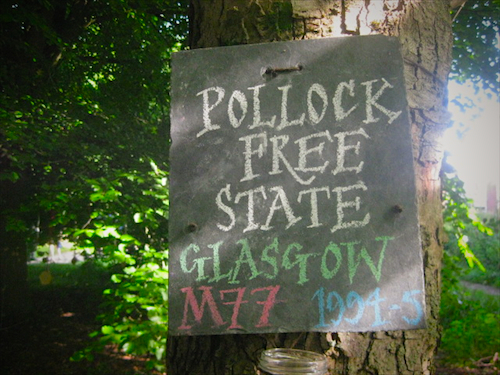
An installation of slate signs by Tom Hirons commemorates protest sites against UK government’s road building programme in the 90s. The commemorative plaques mark the 20-year anniversary of the start of the road protest movement at Twyford Down. It was one of a number of activities focusing on the road protests movement at Dark Mountain’s Uncivlisation 2012 festival this weekend.

Twyford_down

While many individual sites mentioned on these plaques where lost to roads, the protests did seriously damage the prospects for Thatcher’s road building programme, which was significantly reduced as a result of the forest occupations. The protests were, as described in the Uncivilisation 2012 programme; ‘a high-water mark in the history of the UK environmental movement’. Many of the people who were defending these forests, valleys and meadows were nothing short of heroic in their defense of the land. Living up in the trees and buried in the tunnels, winter and summer alike, these forest occupations worked to stop some of the proposed roads. Continue reading

The Green Economy (NOT!): The Final Frontier

Econopoly-web

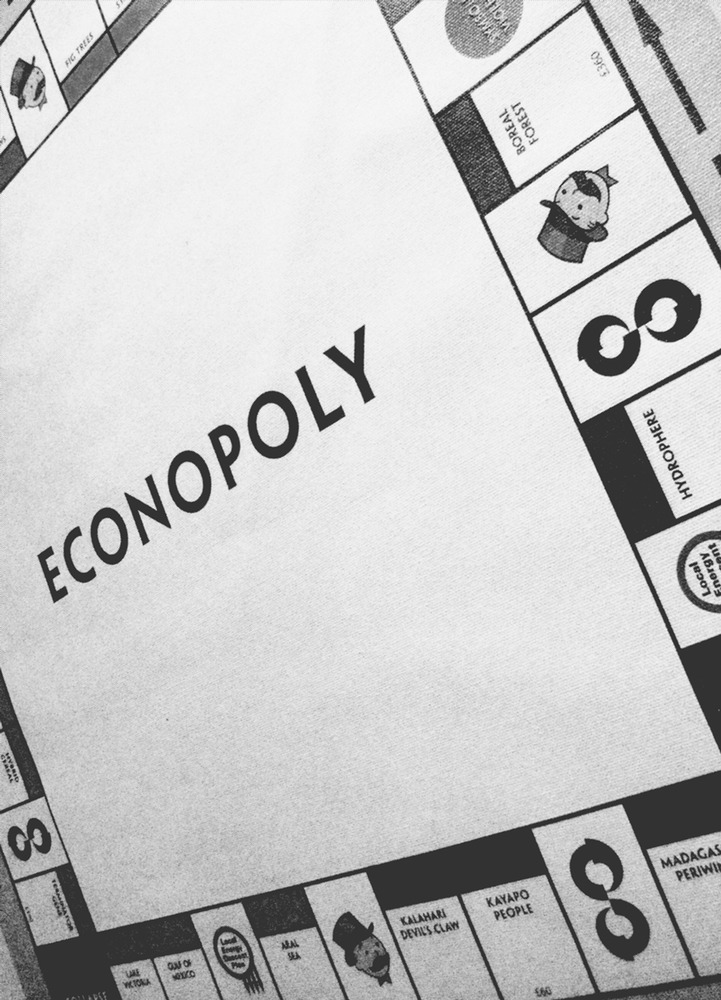
The UN’s Rio+20 declaration ‘The Future We Choose’ warns; ‘the scientific evidence is unequivocal…the time to act is now!’ With this document the UN calls for ‘a great transformation’ emerging from the recognition that business as usual is no longer sufficient. Humankind is now in the ‘Anthropocene’ wherein we must live within the ‘safe operating space of planetary boundaries’. Does this environmental rhetoric demonstrate that the UN is serious about addressing the biodiversity crisis? Or has the UN simply appropriated green language to sell its new project to the global public?

The so-called ‘Green Economy’ launched at Rio+20 reveals a new approach to sustainable development, based on creating new markets for nature’s processes. The basic provisions of the natural world are now ‘ecosystem services’ (water purification, plant pollination, carbon capture and maintenance of soil fertility, etc.). Presently free and commonly shared, the emerging programme will soon quantify, financialise and marketise them. The commodification of the natural world supposedly aims to protect nature by accounting for ‘externalities’ of environmental damage by industry. According to this logic, once nature’s processes are given a financial value, prices of goods and services will reflect ecological costs and it will no longer make economic sense to produce ecologically harmful products.

Continue reading

Design vs. The Design Industry

Stoer_old

Five days ago I uploaded a new paper titled ‘Design vs. The Design Industry: Conflicts in Emergent Orders‘ to the EcoLabs website that has now been downloaded over 470+ times. I should include an explanation as the paper is a bit of an oddity. This paper was not written for design audiences (although it is highly relevant for them). I was invited to write the paper by the ‘Atlas Economic Research Foundation’ and it will be published on this journal on-line hereContinue reading

‘One Planet’ Olympic Games 2012

Olympics-graphic2

The Olympic Games 2012 won their bid partially on the concept of ‘One Planet Olympics’, meaning an Olympics that worked towards lowering its ecological footprint to a level where the earth’s bio-capacity is not diminished. The ecological footprint is a metric that allows us to calculate human pressure on the planet. Tolerance levels are determined by how much stress an ecological system is under due to resource extraction, pollution (including carbon emissions) and other human activities. A key awareness is that critical thresholds can provoke dramatic change and even collapse of ecosystems on various scales. The ‘One Planet’ concept is the challenge of living within the ecological carrying capacity of the earth, essential to avoid risks for civilization that result from destabilized ecosystems.

Unfortunately, the London Olympics Games 2012 are not the ‘One Planet Olympics’. Rather they an abuse of the concept of the concept of living within the Earth’s ecological boundaries. The UK government is spending £11billion+ on the Olympic Games but this same government cannot afford to fund a single independent environmental government watchdog. In 2010 the Sustainable Development Commission, the UK government’s only independent environmental body costing only £3million a year, was abolished. Grandiose green claims and pretensions to aspiring to ‘One Planet’ living are not supported by environmental infrastructure or government policy. Meanwhile the Centre for Alternative Technology in Wales is having to dramatically cut staff. At the Olympics the WWF and BioRegional are helping the UK Government whitewash its image by using the ‘One Planet’ standard for an entirely unsustainable Olympics.

Header

Continue reading

The Politics of Future Visioning – on #FutureScapes

Sony, with the help of Forum for the Future, had launched a project called Futurescapes. The project relies on four scenarios which can be seen on the project website. Typically, these scenarios are not informed by the most menacing dangers to our collective futures. While scenarios can be powerful tools, if scenario builders are not willing critique their own assumptions (especially in terms of ecological realities and social justice) – they are wasting their time (if the goal is exploring sustainable futures). Limiting the analysis in this way, however, IS good for Sony and other corporations interested in inspiring consumer confidence.

Continue reading

Rio+20 – The Green Economy: Not what it appears!

Mono1
Mon2
Bee2

The language in the official UN documents promoting ‘The Green Economy’ published during the Rio+20 UN Conference for Sustainable Development last week is strikingly reflective of the language used by advocates of sustainability and even by social movements. In UN’s declaration ‘The Future We Choose’ certain phrases could have come from a Climate Camp press release; ‘the scientific evidence is unequivocal…the time to act is now!’ The document calls for ‘a great transformation’ and a recognition that business as usual is no longer sufficient in the Anthropocene’ wherein we must live within the ‘safe operating space of planetary boundaries’. Are we finally making progress?

New-logo

Unfortunately what we are witnessing is not progress but an undermining of decades worth of green politics by using of the language of environmentalism while rejecting any accompanying structural analysis of the origins of ecological problems. The UN Green Economy programme uses phrases and rhetorics devices of green movements. Unfortunately, these are neutered of political potential. The Green Economy is about creating new markets for ‘ecosystems services’, the basic provisions of the natural world, now considered ‘free’ such as water purification, plant pollination, carbon capture and maintenance of soil fertility. Creating new markets around these services sets the stage for the expansion of capitalism into the natural world – the global commons.

Financialization of Nature from ATTAC.TV 

The Green Economy is a programme of fixing prices for natural resources once regarded as free. Well-meaning ecologists, scientists and environmental policy makers are now working towards the construction of infrastructure for the financialisation and commodification of ecosystem services. These processes attempt to protect Nature by accounting for ‘externalities’ of environmental damage through economic processes.

Meanwhile, green theorists and social movements claim that without a macroeconomic analysis of the dynamics of neo-liberalism these policies initiatives will reproduce and even increase current problems. Tragically, by bringing neo-liberal economic mechanisms into the sphere of nature, the global commons will be subject to an intensification of exploitation.

Ft_article_on_finaniclisation

Alejandro Nadal, author of Rio+20: A Citizen’s Background Document, explains a fundamental error in the UN’s understanding of the management of the commons. The “global commons” is not what classical Romans called res nullius. Nadal explains that res nullius means that a thing has no owner and, therefore, anyone can appropriate it. Instead of having no owner, the global commons are commonly owned – they are res communis. The global commons must not be an object of private appropriation. We are a community – not commodities ripe for exploitation.

Continue reading

Rio+20 – Saving Biodiversity or Capitalism?

‘Among the issues: What does moving from sustainable development to green economy mean? What is hidden behind this new concept of green economy: green growth? Green capitalism? Something else? What conclusions should we draw from these twenty years, while environmental degradation has accelerated, inequalities have widened and that democracies are being undermined? Which alternatives?’  – from Rio+20: From sustainable development to green economy, what is at stake? Which alternatives? by Alter-Echos 

The United Nations Conference on Sustainable Development Rio+20 next week will address the crisis of biodiversity. Since the first UN conference at Rio in 1992 the UN has attempted to protect the natural world with policy initiatives based in a mistaken understanding of our relationship with the natural world. Even before the Rio 1992 critical environmentalists were aware of the short-comings of the ‘sustainable development’ as an approach for the conservation of nature. David Orton wrote;

Greens and environmentalists who today still use this concept [of sustainable development] display ecological illiteracy. There is a basic contradiction between the finiteness of the Earth, with natural self-regulating systems operating within limits, and the expansionary nature of industrial capitalist society. The language of sustainable development helps mask this fundamental contradiction, so that industrial expansion on a global scale can temporarily continue (Orton 1989).

In short, sustaining or increasing levels of consumption on the diminishing resource base with more people wanting ‘better’ lifestyles (i.e. more consumption) is not possible in the current context. It is not surprising that environmental problems continue to become more severe as policy makers continue to ignore material realities.

The_trial_period_has_ended

Today we find ourselves at a situation where most of the proposals on the table at Rio+20 will only accelerate problems. Strategies promoting ‘the green economy’ create new markets within natural Continue reading