The Role of Design in an Era of Crisis at V&A

Logo

The statement below introduces a seminar at the V&A on September 19th. I will also publish two statements on apolitical design. The events is free but booking is required. 

Does design practice today work for the common good? Are our cultural institutions serving the interests of common people and the planet? While capitalism imposes harsh austerity on the public – it is also increasing profits for elites, the 1%. This dynamic is a threat to democracy and our collective futures, but these dangers are camouflaged by the design industry and our cultural institutions that fail to take the crises we face seriously enough as we head toward unprecedented and irreversible ecocide brought on by the logic of profit for profits sake.

Continue reading

Road Protests, Stories and Politics at Dark Mountain

Pollock

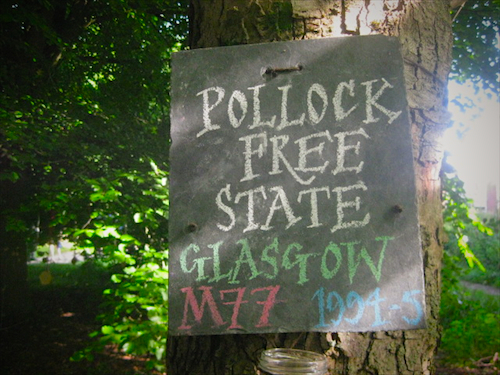
An installation of slate signs by Tom Hirons commemorates protest sites against UK government’s road building programme in the 90s. The commemorative plaques mark the 20-year anniversary of the start of the road protest movement at Twyford Down. It was one of a number of activities focusing on the road protests movement at Dark Mountain’s Uncivlisation 2012 festival this weekend.

Twyford_down

While many individual sites mentioned on these plaques where lost to roads, the protests did seriously damage the prospects for Thatcher’s road building programme, which was significantly reduced as a result of the forest occupations. The protests were, as described in the Uncivilisation 2012 programme; ‘a high-water mark in the history of the UK environmental movement’. Many of the people who were defending these forests, valleys and meadows were nothing short of heroic in their defense of the land. Living up in the trees and buried in the tunnels, winter and summer alike, these forest occupations worked to stop some of the proposed roads. Continue reading

The Green Economy (NOT!): The Final Frontier

Econopoly-web

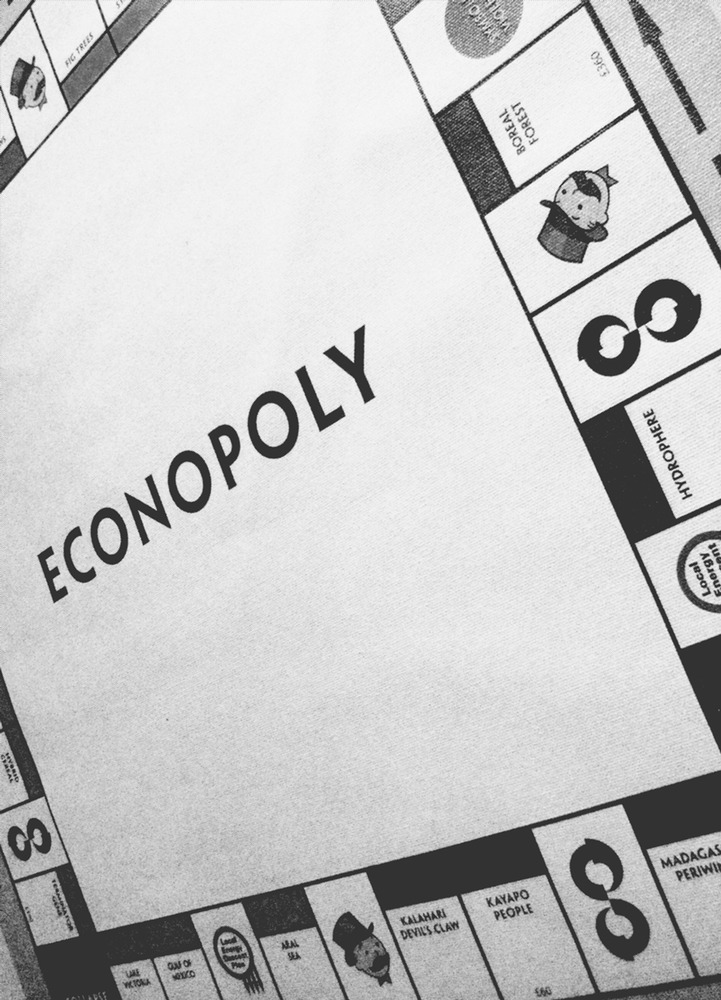
The UN’s Rio+20 declaration ‘The Future We Choose’ warns; ‘the scientific evidence is unequivocal…the time to act is now!’ With this document the UN calls for ‘a great transformation’ emerging from the recognition that business as usual is no longer sufficient. Humankind is now in the ‘Anthropocene’ wherein we must live within the ‘safe operating space of planetary boundaries’. Does this environmental rhetoric demonstrate that the UN is serious about addressing the biodiversity crisis? Or has the UN simply appropriated green language to sell its new project to the global public?

The so-called ‘Green Economy’ launched at Rio+20 reveals a new approach to sustainable development, based on creating new markets for nature’s processes. The basic provisions of the natural world are now ‘ecosystem services’ (water purification, plant pollination, carbon capture and maintenance of soil fertility, etc.). Presently free and commonly shared, the emerging programme will soon quantify, financialise and marketise them. The commodification of the natural world supposedly aims to protect nature by accounting for ‘externalities’ of environmental damage by industry. According to this logic, once nature’s processes are given a financial value, prices of goods and services will reflect ecological costs and it will no longer make economic sense to produce ecologically harmful products.

Continue reading

Design vs. The Design Industry

Stoer_old

Five days ago I uploaded a new paper titled ‘Design vs. The Design Industry: Conflicts in Emergent Orders‘ to the EcoLabs website that has now been downloaded over 470+ times. I should include an explanation as the paper is a bit of an oddity. This paper was not written for design audiences (although it is highly relevant for them). I was invited to write the paper by the ‘Atlas Economic Research Foundation’ and it will be published on this journal on-line hereContinue reading

‘One Planet’ Olympic Games 2012

Olympics-graphic2

The Olympic Games 2012 won their bid partially on the concept of ‘One Planet Olympics’, meaning an Olympics that worked towards lowering its ecological footprint to a level where the earth’s bio-capacity is not diminished. The ecological footprint is a metric that allows us to calculate human pressure on the planet. Tolerance levels are determined by how much stress an ecological system is under due to resource extraction, pollution (including carbon emissions) and other human activities. A key awareness is that critical thresholds can provoke dramatic change and even collapse of ecosystems on various scales. The ‘One Planet’ concept is the challenge of living within the ecological carrying capacity of the earth, essential to avoid risks for civilization that result from destabilized ecosystems.

Unfortunately, the London Olympics Games 2012 are not the ‘One Planet Olympics’. Rather they an abuse of the concept of the concept of living within the Earth’s ecological boundaries. The UK government is spending £11billion+ on the Olympic Games but this same government cannot afford to fund a single independent environmental government watchdog. In 2010 the Sustainable Development Commission, the UK government’s only independent environmental body costing only £3million a year, was abolished. Grandiose green claims and pretensions to aspiring to ‘One Planet’ living are not supported by environmental infrastructure or government policy. Meanwhile the Centre for Alternative Technology in Wales is having to dramatically cut staff. At the Olympics the WWF and BioRegional are helping the UK Government whitewash its image by using the ‘One Planet’ standard for an entirely unsustainable Olympics.

Header

Continue reading

The Politics of Future Visioning – on #FutureScapes

Sony, with the help of Forum for the Future, had launched a project called Futurescapes. The project relies on four scenarios which can be seen on the project website. Typically, these scenarios are not informed by the most menacing dangers to our collective futures. While scenarios can be powerful tools, if scenario builders are not willing critique their own assumptions (especially in terms of ecological realities and social justice) – they are wasting their time (if the goal is exploring sustainable futures). Limiting the analysis in this way, however, IS good for Sony and other corporations interested in inspiring consumer confidence.

Continue reading

Rio+20 – The Green Economy: Not what it appears!

Mono1
Mon2
Bee2

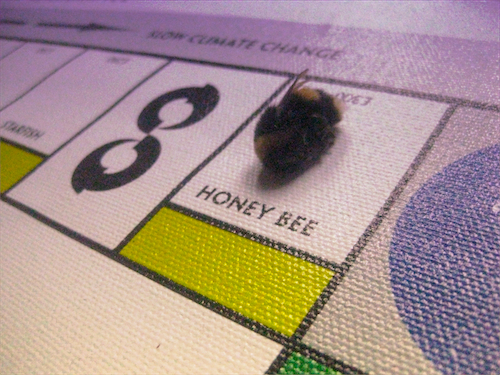
The language in the official UN documents promoting ‘The Green Economy’ published during the Rio+20 UN Conference for Sustainable Development last week is strikingly reflective of the language used by advocates of sustainability and even by social movements. In UN’s declaration ‘The Future We Choose’ certain phrases could have come from a Climate Camp press release; ‘the scientific evidence is unequivocal…the time to act is now!’ The document calls for ‘a great transformation’ and a recognition that business as usual is no longer sufficient in the Anthropocene’ wherein we must live within the ‘safe operating space of planetary boundaries’. Are we finally making progress?

New-logo

Unfortunately what we are witnessing is not progress but an undermining of decades worth of green politics by using of the language of environmentalism while rejecting any accompanying structural analysis of the origins of ecological problems. The UN Green Economy programme uses phrases and rhetorics devices of green movements. Unfortunately, these are neutered of political potential. The Green Economy is about creating new markets for ‘ecosystems services’, the basic provisions of the natural world, now considered ‘free’ such as water purification, plant pollination, carbon capture and maintenance of soil fertility. Creating new markets around these services sets the stage for the expansion of capitalism into the natural world – the global commons.

Financialization of Nature from ATTAC.TV 

The Green Economy is a programme of fixing prices for natural resources once regarded as free. Well-meaning ecologists, scientists and environmental policy makers are now working towards the construction of infrastructure for the financialisation and commodification of ecosystem services. These processes attempt to protect Nature by accounting for ‘externalities’ of environmental damage through economic processes.

Meanwhile, green theorists and social movements claim that without a macroeconomic analysis of the dynamics of neo-liberalism these policies initiatives will reproduce and even increase current problems. Tragically, by bringing neo-liberal economic mechanisms into the sphere of nature, the global commons will be subject to an intensification of exploitation.

Ft_article_on_finaniclisation

Alejandro Nadal, author of Rio+20: A Citizen’s Background Document, explains a fundamental error in the UN’s understanding of the management of the commons. The “global commons” is not what classical Romans called res nullius. Nadal explains that res nullius means that a thing has no owner and, therefore, anyone can appropriate it. Instead of having no owner, the global commons are commonly owned – they are res communis. The global commons must not be an object of private appropriation. We are a community – not commodities ripe for exploitation.

Continue reading

Rio+20 – Saving Biodiversity or Capitalism?

‘Among the issues: What does moving from sustainable development to green economy mean? What is hidden behind this new concept of green economy: green growth? Green capitalism? Something else? What conclusions should we draw from these twenty years, while environmental degradation has accelerated, inequalities have widened and that democracies are being undermined? Which alternatives?’  – from Rio+20: From sustainable development to green economy, what is at stake? Which alternatives? by Alter-Echos 

The United Nations Conference on Sustainable Development Rio+20 next week will address the crisis of biodiversity. Since the first UN conference at Rio in 1992 the UN has attempted to protect the natural world with policy initiatives based in a mistaken understanding of our relationship with the natural world. Even before the Rio 1992 critical environmentalists were aware of the short-comings of the ‘sustainable development’ as an approach for the conservation of nature. David Orton wrote;

Greens and environmentalists who today still use this concept [of sustainable development] display ecological illiteracy. There is a basic contradiction between the finiteness of the Earth, with natural self-regulating systems operating within limits, and the expansionary nature of industrial capitalist society. The language of sustainable development helps mask this fundamental contradiction, so that industrial expansion on a global scale can temporarily continue (Orton 1989).

In short, sustaining or increasing levels of consumption on the diminishing resource base with more people wanting ‘better’ lifestyles (i.e. more consumption) is not possible in the current context. It is not surprising that environmental problems continue to become more severe as policy makers continue to ignore material realities.

The_trial_period_has_ended

Today we find ourselves at a situation where most of the proposals on the table at Rio+20 will only accelerate problems. Strategies promoting ‘the green economy’ create new markets within natural Continue reading

Canadian Policing: G20 Systemic Review Report

Citizen_not_terrorist

I was visiting my father during the G20 in Toronto so I had the opportunity to take part in the demonstrations. I witnessed a phenomenal amount of police violence over the course of the weekend. While I was not assaulted or arrested myself, I gave evidence on police misconduct to the Office of the Independent Police Review Director (OIPRD) G20 Systemic Review Report on what I saw happen to less fortunate people on the streets.

Continue reading

What Next? The Rise of Authoritarian Housing

In the UK the homeless have traditionally been allowed to legally occupy long-term empty property. These rights were critical at key moments in history (such as after the WW2 when Britain experienced a housing crisis and squatting was rife). Squatters’ rights came to an end on March 27th when the government criminalised squatting* in residential properties (the new law will come into effect in a matter of months).

Img_1818

I sent a Freedom of Information request to Lambeth Council to investigate the costs of evicting a long term squatted building in Brixton last summer. In July last year Lambeth Council evicted Clifton Mansions, a council owned block of 22 Victorian flats that have been squatted for the past two decades. Clifton Mansions is typical of a property that had been left derelict because its owners have not bothered to make use of it. Instead, individuals took it upon themselves to make homes for themselves in the flats at no cost to the state. While squatting may be detestable to those who hold property rights as the bedrock of civilization, for many squatting is a pragmatic solution to the extraordinarily high costs of housing and the surplus of houses that stand empty, unused and wasted. Continue reading

London Premier of ‘An Ecology of Mind’

Yesterday night I attended the London premier of Nora Bateson’s film: An Ecology of Mind: A Daughter’s Portrait of Gregory Bateson. Gregory Bateson has been described as ‘the most important thinker you’ve never heard of‘, an intellectual renegade who contributed to a variety of disciplinary traditions, earning him an array of diverse followers. Bateson fans are always independent thinkers, often ecological thinkers and sometimes critical thinkers. This blog will briefly review some main themes in Bateson’s legacy, its potential and hint at some of the issues that keep ecological thought from achieving its goals.

The event was organised by critical urban ecologist Jon Goodbun and hosted by the University of Westminster. Jon shares my interest in Gregory Bateson’s seminal work on the nature of mind, epistemological challenges to current ways of knowing and the critical importance of ecological thought in addressing contemporary challenges. Jon kindly invited me to sit on the panel with Nora Bateson, Iain Boal, Wendy Wheeler, Ranulph Glanville and Peter Reason after the screening.

Continue reading

Face Shields and Time2Act Exhibition

Img_6852

On exhibition this week at London College of Communication is a series of eight iconic Face Shields and four panels from the Time2Act exhibition from Climate Camp 2007 at Heathrow Airport. Both bodies of work are important artefacts from the recent history of environmental activism in the UK.

Continue reading

Design as Manipulation. Design as Emancipation.

My presentation at the launch of Occupy Design UK.

Communication design is used to sell products – but even when it is not explicitly engaged in manufacturing consumer desire, design can function to conceal the impacts of conspicuous consumption and the socio-political-economic system through a process known as symbolic violence. While communication design can be used to reveal consequences, illustrate systemic dynamics and facilitate public processes – capitalism needs designers to promote consumption not to critique consumption! The values embedded in capitalism are reproduced by the design industry. Communication design serves not only to whitewash the destructive practices of corporate entities but to perpetuate the point of view of the culturally, politically and economically powerful.

While there is some vague anti-consumerist and anti-corporate rhetoric in design circles – a cynical stance, on its own, will not transform the dysfunctional political systems. What is urgently needed in design is new form of politically, socially and ecologically engaged design practice. The work of building new social relations that can resist and transform political and economic institutions requires transparent, truthful and participatory communication systems. Designers must engage with social movements who have a legacy of creating agency and developing the means to see through oppressive cultural practices. In this way design can become a force for emancipation rather than manipulation.