Capitalism in Context – The Occupied Times #8

Pages_from_ot8_jody

While corporations are busy marketing themselves as environmentally responsible global citizens, scientists warn that global ecological systems are severely destabilised. The confusion created by the gap between frightening scientific reports and reassuring messages from advertising and corporate media provides an excuse to continue shopping, watching TV and generally ignoring escalating social, political and economic crises (as long as you happen to be privileged enough to avoid the immediate impacts).

Business as usual continues because capitalism denies its own ecological (and social) context. Communication processes directed by the market obscure the environmental consequences of industrial processes. The failure to recognize ecological context creates a basic schism between the environment and the market economy.

When markets determine what information is available in the public sphere, ‘knowledge’ comes to reflect what is profitable for those with economic power. This representation of the truth rarely takes the Earth’s needs into account. Though efforts are made by hopeful environmentalists to create a basic understanding of environmental context, their efforts are vastly overshadowed by the onslaught of corporate advertising and spin.

Continue reading

Trash Culture

Img_1518

I live in central Brixton. On my road boxes of fliers are often abandoned by flier delivery companies. In the lobby of my flat they throw heaps of junk mail no one wants. Today, even my supposedly ethical vegetable box delivery company, Abel & Cole, dumped 18 fliers in the door way of my building – despite the fact that there are only 8 flats. All this advertising goes straight from the mess it makes Continue reading

Capitalism in Context (Version No.1)

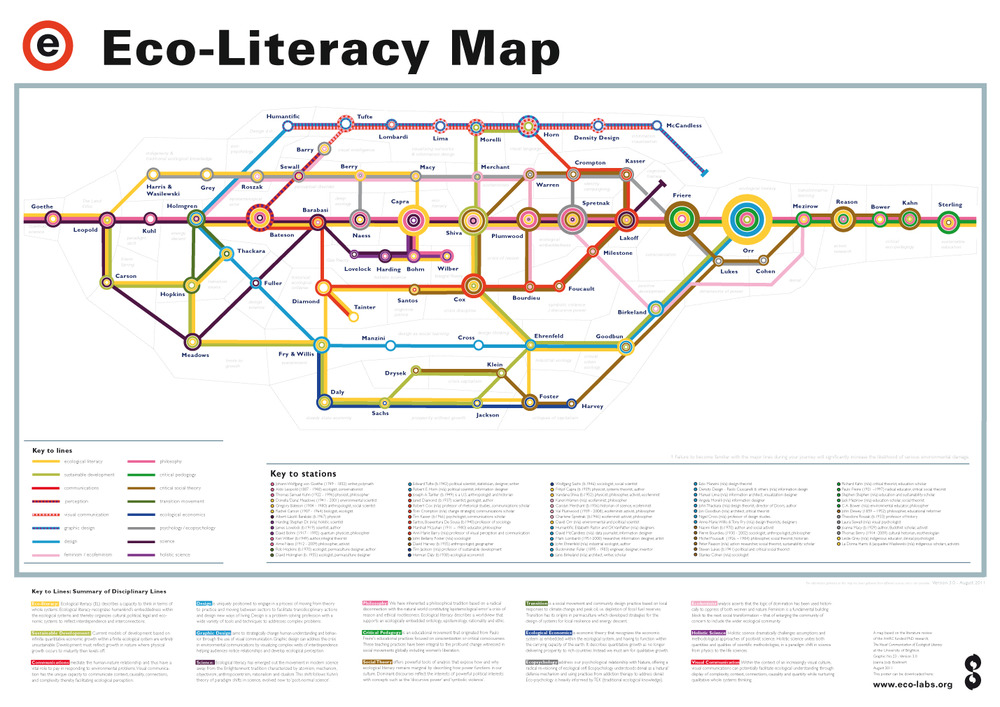
Discourse-modellogos

While corporations are busy marketing themselves as environmentally responsible global citizens, scientists warn that global ecological systems are severely destabilized and three planetary boundaries are presently being crossed (biodiversity, climate change and the nitrogen cycle). The confusion created by the gap between frightening scientific reports and reassuring messaging from advertising and corporate media is a good enough excuse to continue shopping, TV watching and generally ignoring escalating social/ political/ economic crises (as long as you happen to be privileged enough to avoid the immediate impacts). Business as usual continues as both knowledge and reason are distorted by market forces. When markets determine what information is available in the public sphere ‘knowledge’ comes to reflect what is profitable for those with economic power. This distorted knowledge rarely takes the earth’s needs into account. While efforts are made by hopeful environmentalists and NGOs to create ecologically and socially beneficial projects and tweak the market to recognize the value of the natural processes, the overall dynamic of capitalism leads to greater ecological devastation.

Continue reading

History of EcoSocial Movements

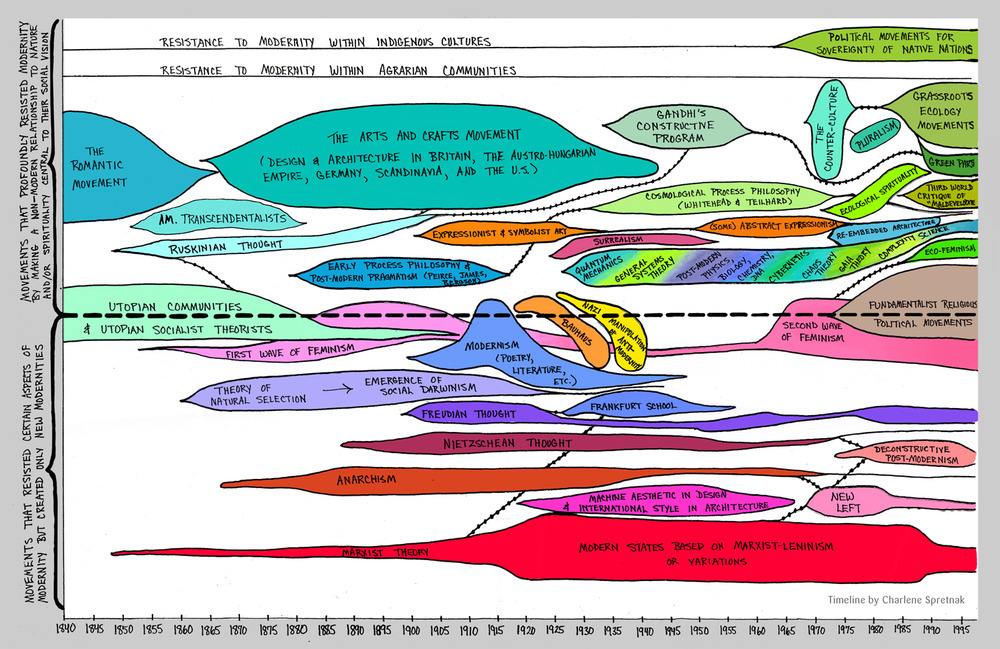
The ‘History of EcoSocial Movements 1840-1995’ by Charlene Spretnak illustrates the relationship between social movements which ‘profoundly resisted modernity’ versus those that ‘resisted certain aspects of modernity but created only new modernities’.  This graphic maps an array of discursive positions demonstrating interrelationships. The political neutralization of historical social movements demanding structural change informs contemporary analysis of threats to the occupy movement.

History of EcoSocial Movements (1840-1995)

Charlene-spretnak-colour-web

Movements that challenged modernity are above the broken line. Source: Charlene Spretnak, The Resurgence of the Real (Routledge paperback edition, 1999). Colourized and republished with permission from Charlene Spretnak.

All Men on the Podium

I was confronted with another exclusively male panel this week. It was at the RSA (again). Unfortunately, the RSA is not alone. Ellie Mae O’Hagan wrote this week ‘on misogyny and female columnists‘ in the New Statesman. Many activists communities often replicate the same man on the podium women as supporter, organiser and helper model.  I blogged about the problem at a “Radical” Communication Festival (and received 57 comments). In my experience this problem is evident in the Transition movement. I have heard stories about it being a problem in Uk-Uncut and I am aware that women have been organising to address the problem in the Dark Mountain community. Women tell me that it bothers them but they would not like to consider themselves the kind of woman who publicly challenges these all male line ups. Why not? How did womankind slip into such passivity only a couple decades after our mothers’ demanded that they were heard and granted the rights we now enjoy. How come our historical memory is so short? Continue reading

American Holiday

Last week I presented an paper on structural obstacles that perpetuate ecological problems. More bluntly, this paper was a critique of capitalism in terms of the manner in which its processes destroy designers’ capacity to create sustainable ways of living. The paper was called ‘Design vs. the Design Industry’ (presently being re-written) and the conference was on spontaneous orders, otherwise known as emergent orders. My trip and the event was sponsored by The Atlas Foundation, a group associated with classical liberals, libertarians or free-market thinkers supporting the philosophies of the likes of Friederick Hayek and Ayn Rand. In contrast, my paper explained why the design industries are unable to make sustainability possible when directed by the systemic goals of the capitalism. Despite the fact that designers have emergent capacities to address larger social and ecological problems, capitalism will continue to direct energies of individual designers towards systemic priorities which are increasingly anti-social and anti-ecological. Continue reading

Design History Society does Design Activism

I returned last night from four busy days at the Design History Society’s Design Activism and Social Change conference in Barcelona. Convenor Guy Julier has a more thorough conference blog here. The conference provided a space to debate emergent themes in design activism: politics and design, ecology and design, the role of agency, reflection vs. action, the importance of the language we use, peak oil and the capacity of design to address social and environmental problems within capitalism and current forms of democracy. The event started well with Henk Oosterling’s keynote describing a movement to a philosophy of relations. Attempts to repress ontological connectedness are destructive and a role of design is now to internalise what is currently externalised in order to better reflect the essential conditions of connectedness.

Continue reading

Hopenhagen: Design Activism as an Oxymoron

Hopenhagen was an initiative by the International Advertising Association in support of the United Nations at the UN Climate Change Conference (COP-15) in Copenhagen December 2009. The UN Secretary-General Ban Ki-moon UN asked for help from the international advertising industry at Davos in January 2009. Hopenhagen took the form of an international public relations campaign culminating with an installation in the public square in central Copenhagen during the COP-15 summit. Hopenhagen created a feel good façade where corporate sponsors were helping governments save the world.

Meanwhile, many of the thousands of climate activists congregated in Copenhagen for the summit found Hopenhagen so offensive that they made the campaign and installation itself an object of their protests. Hopenhagen is a classic example of corporate appropriation of people’s movements and the subsequent neutralization of the messages demanding structural change and social justice. As such, Hopenhagen embodies the conflict within the concept of design activism itself. While design functions predominately as a driver of consumption, consumerism, globalization and unsustainable behavior; activism is concerned with social injustice and environmental devastation. Activists struggle to combat the forces of globalization by forming social movements and resisting corporatisation of the commons and everyday life; designers are normally servant of corporate entities. These two forces are integrally at odds.

Continue reading

Design vs the Design Industry

I have just finished a new paper for the Studies in Emergent Order journal. I found the framework of emergence helpful in describing problems with design and ecological crisis. I am looking forward making the paper public, but for the moment all I can post is this abstract.

Design as an Emergent Order and ‘Tensions’ with the Market

As the professional practice of creating new products, buildings, services, infrastructure and communication, design manifests the creative vision of individual designers for solutions to meet human needs and desires. Design is an emergent order that evolves as the skills and capacities of designers change with new technology and communications practices. New cognitive and perceptual capacities enable a greater understanding of complexity, context and system dynamics creating the potential better solutions to contemporary problems. Yet despite emergent skills, designers are not able to effectively address contemporary problems due to ‘tensions’ with the emergent order of the market. Critically, ‘design’ is not the same as the ‘design industry’. This paper will describe design as an emergent order with a specific focus on communication design and the profound conflicts between this order and the market. This conflict results in distortions of knowledge and reason with severe consequences.

** I am using the word ‘tensions’ because this is the word used in the call for papers. In the context of my paper it is an extreme understatement.

Econopoly: On Ecosystems and Economics

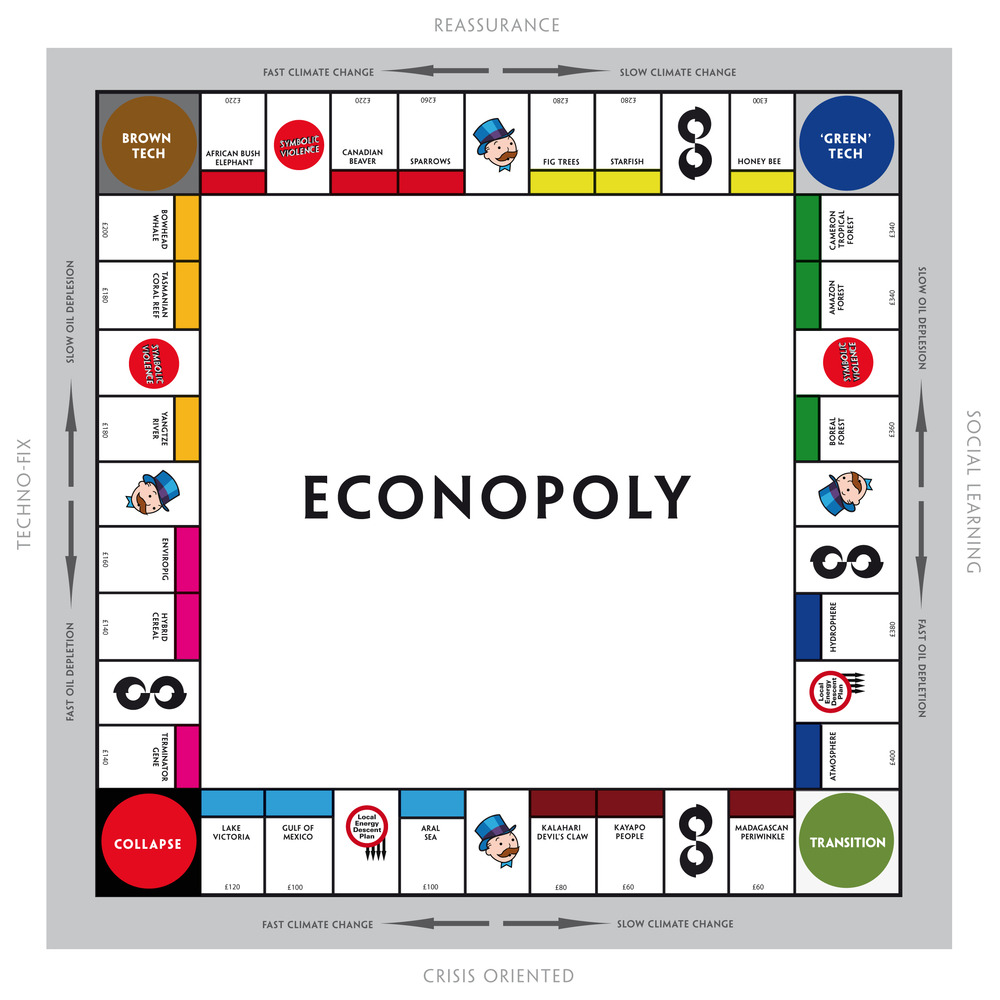
Econopoly: Phase One of Ecology Games 2012

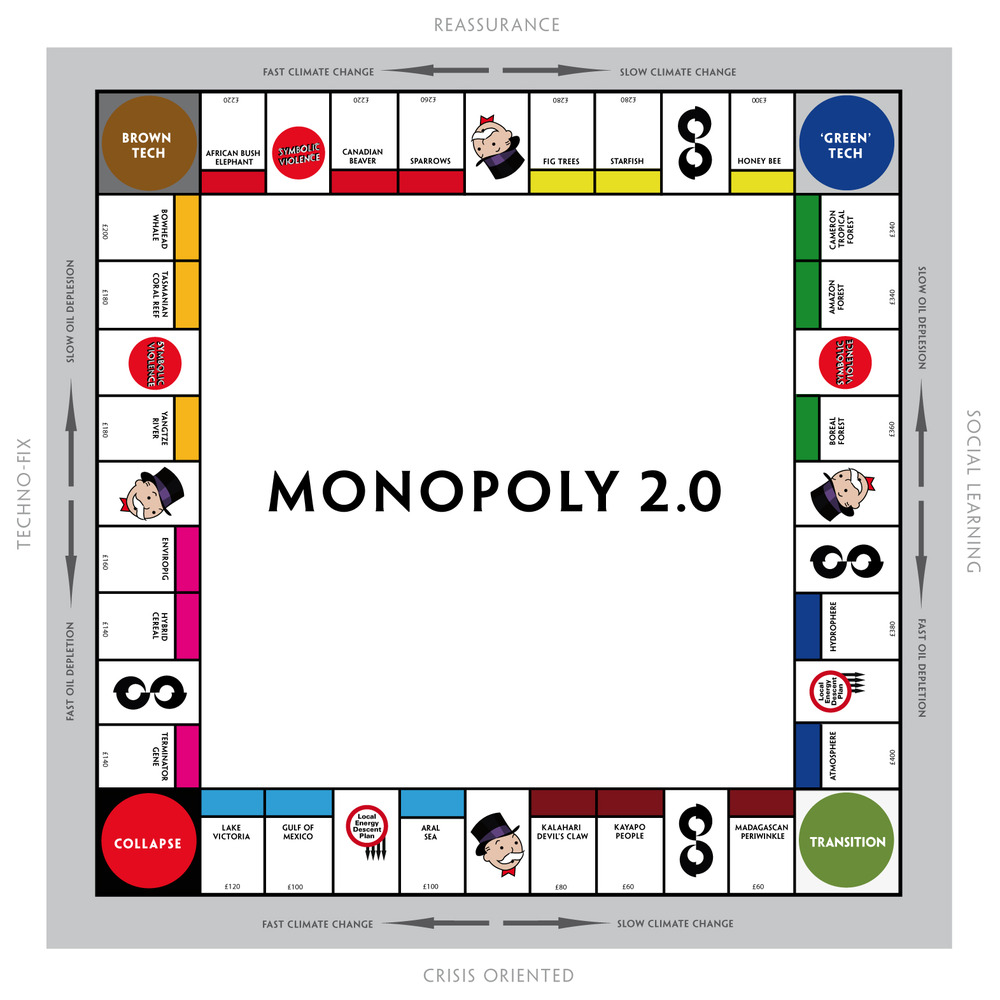
The original game of Monopoly was invented by a Quaker woman called Elizabeth Magie in 1903 (and originally called The Landlord’s Game). Elizabeth Magie’s game intended to demonstrate the injustices of Henry George’s Single Tax on land but instead Parker Brothers bought the rights and made a game about buying property, making monopolies and beating other players by charging them rent.

Econopoly is about the commodification of the natural world. Presently, ecological ‘services’ are being given financial value in a desperate effort to convince industrialists to acknowledge the importance of Nature. The financialisation of ‘ecosystem services’ is based on the belief this will help protect biodiversity. But does assigning ecosystems an economic value really work?

Consider the recent The Economics of Ecosystems and Biodiversity (TEEB) report, which estimates a total economic value of insect pollination worldwide at €153 billion (Gallai et al. 2009 in TEEB, 2010: p.8). It’s a high number, but does this number actually reflect the value of pollinating insects? Considering that we are dependent on functioning ecological systems, surely these ‘ecosystem services’ and the pollinating insects which are a vital part of these ecosystems are in fact priceless. Continue reading

Eco-Labs.org v. Ecolab.com – Sanity prevails………. We win!

We have just received the good news that the www.Eco-Labs.org vs. www.ecolab.com case at the National Arbitration Forum has been decided in our favour. Ten pages of legal case work conclude with the statement: ‘Accordingly, it is ordered that the <eco-labs.org> domain name has to REMAIN WITH Respondent.’  In light of this decision, we expect that Ecolab.com (the $5bn chemical cleaning and pest extermination company) will stop harassing us. We have more important matters to address than legal battles over our name. I am grateful to the dozens of people who contributed to the the funding appeal to help pay the lawyer’s bill. Thanks to Jim Killock at the Open Rights Group for convincing me that people would care and it was possible to ask for help. Continue reading

Socially Responsive Communication at Memefest

Sl385534

 Having just spent a week working at Memefest Festival of Radical Communications on mapping socially responsive communications, I had the opportunity to reflect on what it means to make communications that address societal problems. Oliver Vodeb described seven characteristics of socially responsive communications as a starting point from which the group assembled to build on the theory by creating new maps. While intrigued by Vodeb’s work and appreciating its relevance I believe that something is missing.

Socially responsive communications must also address ecological problems because we are all ultimately completely dependent on the wellbeing of the ecological system for social wellbeing. The consequences of ecological degradation are more keenly felt by the poor and the least politically powerful so the environment is also about social justice. Powerful forces have a vested interest in representations of the nature as ‘resources’ available for industrial exploitation and actively work to suppress communications that challenge this orthodoxy. As the impact of ecological problems increasingly drives social problems, representations of the environment is a primary site of struggle. Continue reading

The Issue of 100% Male Conference Panels

Tony_presenting

I was the woman who asked the exclusively male panel at Memefest’s Festival of Radical Communications ‘Inspiration day‘ why there were no women presenters. I think it’s worth unpacking this topic a little with the  intention of helping Memefest develop into an network with strong input from women and other marginalised voices. Diversity of representation should by now be standard practice in any international  network, but is especially critical for one that aspires to represent a radical tradition.

Continue reading

EcoLabs under Threat: Corporate Encroachment of ‘eco’ and ‘labs’

Logo-onwhile

EcoLabs is a small non-profit environmental education organisation based in London. We are engaged in research, design and visual communication of complex ideas and ecological literacy. We have been doing this work under the name EcoLabs – the ecological literacy initiative since 2006. We publish all our award-winning designs work for free on-line (thousands of visual resources have been downloaded on our website – www.eco-labs.org).

Meanwhile, a corporation called Ecolab is a 60 year old multi-national with a turn-over of over $6bn/year. They sell sanitation, food safety and pest extermination products and services. Last year Ecolab sent us (and our Internet provider) a series of threatening letters. We took legal council and our lawyer argued that Eco-Labs.org is entitled to use the words ‘eco’ and ‘labs’ in this context. Last week we received notice that Ecolab.com are again attempting to force EcoLabs to change our domain name. The case will be overseen by National Arbitration Forum  in Minneapolis at the end of May.

The prefix ‘ECO‘ is in common usage, being shorthand for the term ‘ecological’. The term ‘LABS‘ refers to the research and development conducted as part of our communication design practice. Both words are so common that it is absurd for a corporate entity to assume the legal right to prevent others from combining these two ideas together. Language is a commons resource freely available to us all to reinvent and modify as we evolve. It sets a problematic precedent to allow corporations to define what can be called ‘eco’ or ‘labs’. Continue reading