I was visiting my father during the G20 in Toronto so I had the opportunity to take part in the demonstrations. I witnessed a phenomenal amount of police violence over the course of the weekend. While I was not assaulted or arrested myself, I gave evidence on police misconduct to the Office of the Independent Police Review Director (OIPRD) G20 Systemic Review Report on what I saw happen to less fortunate people on the streets.
Author Archives for Dr. Joanna Boehnert
What Next? The Rise of Authoritarian Housing
In the UK the homeless have traditionally been allowed to legally occupy long-term empty property. These rights were critical at key moments in history (such as after the WW2 when Britain experienced a housing crisis and squatting was rife). Squatters’ rights came to an end on March 27th when the government criminalised squatting* in residential properties (the new law will come into effect in a matter of months).
I sent a Freedom of Information request to Lambeth Council to investigate the costs of evicting a long term squatted building in Brixton last summer. In July last year Lambeth Council evicted Clifton Mansions, a council owned block of 22 Victorian flats that have been squatted for the past two decades. Clifton Mansions is typical of a property that had been left derelict because its owners have not bothered to make use of it. Instead, individuals took it upon themselves to make homes for themselves in the flats at no cost to the state. While squatting may be detestable to those who hold property rights as the bedrock of civilization, for many squatting is a pragmatic solution to the extraordinarily high costs of housing and the surplus of houses that stand empty, unused and wasted. Continue reading
London Premier of ‘An Ecology of Mind’
Yesterday night I attended the London premier of Nora Bateson’s film: An Ecology of Mind: A Daughter’s Portrait of Gregory Bateson. Gregory Bateson has been described as ‘the most important thinker you’ve never heard of‘, an intellectual renegade who contributed to a variety of disciplinary traditions, earning him an array of diverse followers. Bateson fans are always independent thinkers, often ecological thinkers and sometimes critical thinkers. This blog will briefly review some main themes in Bateson’s legacy, its potential and hint at some of the issues that keep ecological thought from achieving its goals.
The event was organised by critical urban ecologist Jon Goodbun and hosted by the University of Westminster. Jon shares my interest in Gregory Bateson’s seminal work on the nature of mind, epistemological challenges to current ways of knowing and the critical importance of ecological thought in addressing contemporary challenges. Jon kindly invited me to sit on the panel with Nora Bateson, Iain Boal, Wendy Wheeler, Ranulph Glanville and Peter Reason after the screening.
Animation: Energy Supply & Infinite Growth
Animated documentary about resource depletion & the impossibility of infinite growth on a finite planet. Fine first production by http://www.incubatepictures.com
Face Shields and Time2Act Exhibition
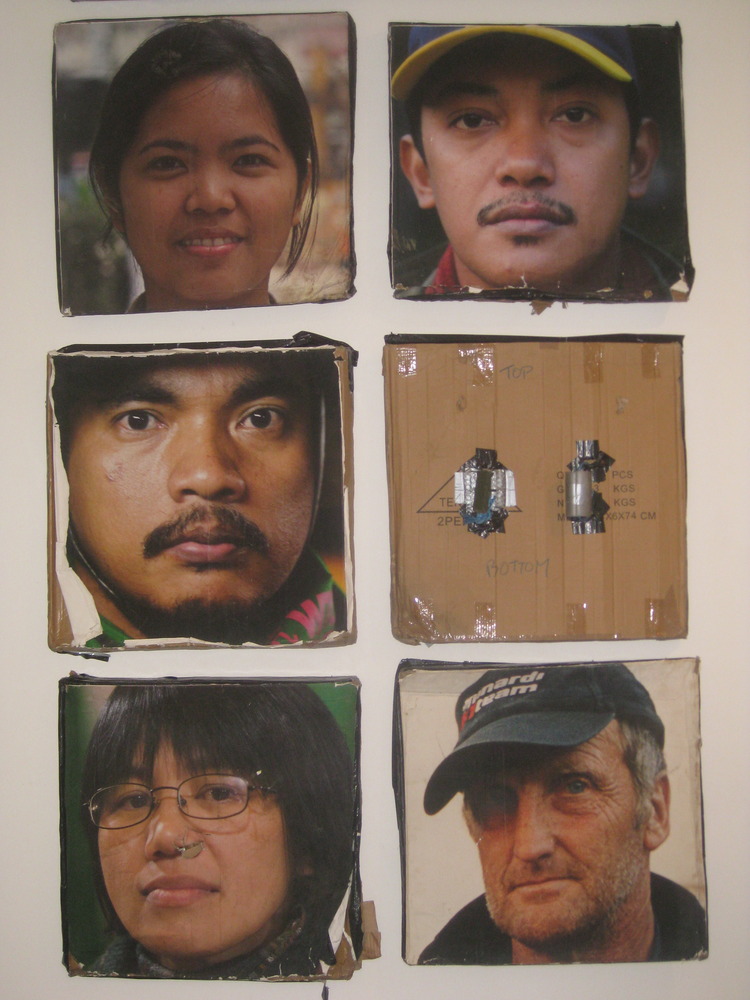
On exhibition this week at London College of Communication is a series of eight iconic Face Shields and four panels from the Time2Act exhibition from Climate Camp 2007 at Heathrow Airport. Both bodies of work are important artefacts from the recent history of environmental activism in the UK.
Design as Manipulation. Design as Emancipation.
My presentation at the launch of Occupy Design UK.
Communication design is used to sell products – but even when it is not explicitly engaged in manufacturing consumer desire, design can function to conceal the impacts of conspicuous consumption and the socio-political-economic system through a process known as symbolic violence. While communication design can be used to reveal consequences, illustrate systemic dynamics and facilitate public processes – capitalism needs designers to promote consumption not to critique consumption! The values embedded in capitalism are reproduced by the design industry. Communication design serves not only to whitewash the destructive practices of corporate entities but to perpetuate the point of view of the culturally, politically and economically powerful.
While there is some vague anti-consumerist and anti-corporate rhetoric in design circles – a cynical stance, on its own, will not transform the dysfunctional political systems. What is urgently needed in design is new form of politically, socially and ecologically engaged design practice. The work of building new social relations that can resist and transform political and economic institutions requires transparent, truthful and participatory communication systems. Designers must engage with social movements who have a legacy of creating agency and developing the means to see through oppressive cultural practices. In this way design can become a force for emancipation rather than manipulation.
PROTECT IP / SOPA Act Breaks the Internet
Capitalism in Context – The Occupied Times #8
While corporations are busy marketing themselves as environmentally responsible global citizens, scientists warn that global ecological systems are severely destabilised. The confusion created by the gap between frightening scientific reports and reassuring messages from advertising and corporate media provides an excuse to continue shopping, watching TV and generally ignoring escalating social, political and economic crises (as long as you happen to be privileged enough to avoid the immediate impacts).
Business as usual continues because capitalism denies its own ecological (and social) context. Communication processes directed by the market obscure the environmental consequences of industrial processes. The failure to recognize ecological context creates a basic schism between the environment and the market economy.
When markets determine what information is available in the public sphere, ‘knowledge’ comes to reflect what is profitable for those with economic power. This representation of the truth rarely takes the Earth’s needs into account. Though efforts are made by hopeful environmentalists to create a basic understanding of environmental context, their efforts are vastly overshadowed by the onslaught of corporate advertising and spin.
Trash Culture
I live in central Brixton. On my road boxes of fliers are often abandoned by flier delivery companies. In the lobby of my flat they throw heaps of junk mail no one wants. Today, even my supposedly ethical vegetable box delivery company, Abel & Cole, dumped 18 fliers in the door way of my building – despite the fact that there are only 8 flats. All this advertising goes straight from the mess it makes Continue reading
Capitalism in Context (Version No.1)
While corporations are busy marketing themselves as environmentally responsible global citizens, scientists warn that global ecological systems are severely destabilized and three planetary boundaries are presently being crossed (biodiversity, climate change and the nitrogen cycle). The confusion created by the gap between frightening scientific reports and reassuring messaging from advertising and corporate media is a good enough excuse to continue shopping, TV watching and generally ignoring escalating social/ political/ economic crises (as long as you happen to be privileged enough to avoid the immediate impacts). Business as usual continues as both knowledge and reason are distorted by market forces. When markets determine what information is available in the public sphere ‘knowledge’ comes to reflect what is profitable for those with economic power. This distorted knowledge rarely takes the earth’s needs into account. While efforts are made by hopeful environmentalists and NGOs to create ecologically and socially beneficial projects and tweak the market to recognize the value of the natural processes, the overall dynamic of capitalism leads to greater ecological devastation.
History of EcoSocial Movements
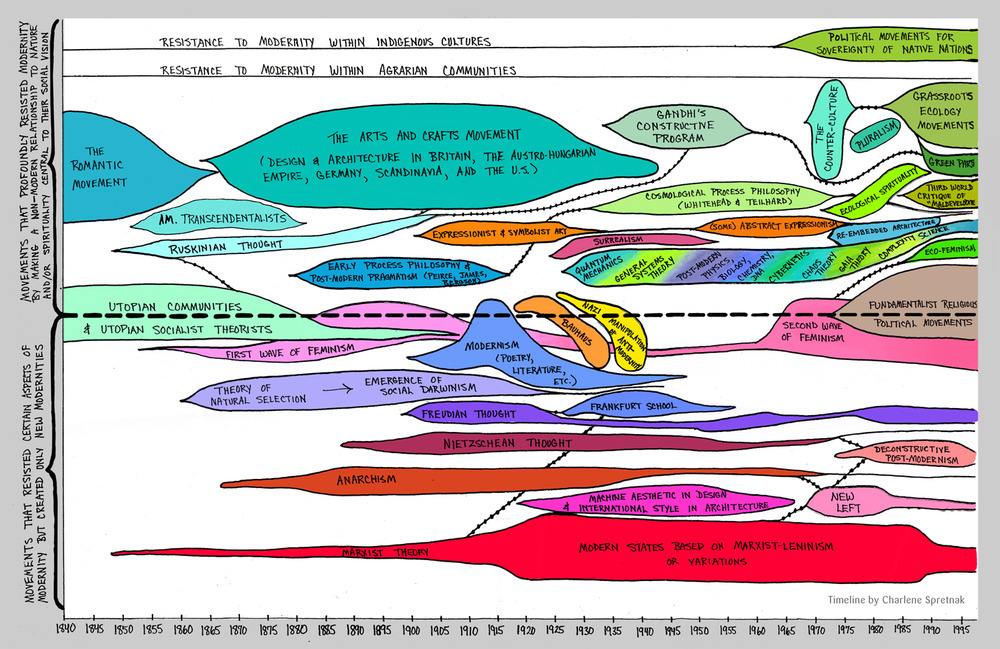
The ‘History of EcoSocial Movements 1840-1995’ by Charlene Spretnak illustrates the relationship between social movements which ‘profoundly resisted modernity’ versus those that ‘resisted certain aspects of modernity but created only new modernities’. This graphic maps an array of discursive positions demonstrating interrelationships. The political neutralization of historical social movements demanding structural change informs contemporary analysis of threats to the occupy movement.
History of EcoSocial Movements (1840-1995)
Movements that challenged modernity are above the broken line. Source: Charlene Spretnak, The Resurgence of the Real (Routledge paperback edition, 1999). Colourized and republished with permission from Charlene Spretnak.
All Men on the Podium
I was confronted with another exclusively male panel this week. It was at the RSA (again). Unfortunately, the RSA is not alone. Ellie Mae O’Hagan wrote this week ‘on misogyny and female columnists‘ in the New Statesman. Many activists communities often replicate the same man on the podium women as supporter, organiser and helper model. I blogged about the problem at a “Radical” Communication Festival (and received 57 comments). In my experience this problem is evident in the Transition movement. I have heard stories about it being a problem in Uk-Uncut and I am aware that women have been organising to address the problem in the Dark Mountain community. Women tell me that it bothers them but they would not like to consider themselves the kind of woman who publicly challenges these all male line ups. Why not? How did womankind slip into such passivity only a couple decades after our mothers’ demanded that they were heard and granted the rights we now enjoy. How come our historical memory is so short? Continue reading
American Holiday
Last week I presented an paper on structural obstacles that perpetuate ecological problems. More bluntly, this paper was a critique of capitalism in terms of the manner in which its processes destroy designers’ capacity to create sustainable ways of living. The paper was called ‘Design vs. the Design Industry’ (presently being re-written) and the conference was on spontaneous orders, otherwise known as emergent orders. My trip and the event was sponsored by The Atlas Foundation, a group associated with classical liberals, libertarians or free-market thinkers supporting the philosophies of the likes of Friederick Hayek and Ayn Rand. In contrast, my paper explained why the design industries are unable to make sustainability possible when directed by the systemic goals of the capitalism. Despite the fact that designers have emergent capacities to address larger social and ecological problems, capitalism will continue to direct energies of individual designers towards systemic priorities which are increasingly anti-social and anti-ecological. Continue reading
Design History Society does Design Activism
I returned last night from four busy days at the Design History Society’s Design Activism and Social Change conference in Barcelona. Convenor Guy Julier has a more thorough conference blog here. The conference provided a space to debate emergent themes in design activism: politics and design, ecology and design, the role of agency, reflection vs. action, the importance of the language we use, peak oil and the capacity of design to address social and environmental problems within capitalism and current forms of democracy. The event started well with Henk Oosterling’s keynote describing a movement to a philosophy of relations. Attempts to repress ontological connectedness are destructive and a role of design is now to internalise what is currently externalised in order to better reflect the essential conditions of connectedness.
Hopenhagen: Design Activism as an Oxymoron
Meanwhile, many of the thousands of climate activists congregated in Copenhagen for the summit found Hopenhagen so offensive that they made the campaign and installation itself an object of their protests. Hopenhagen is a classic example of corporate appropriation of people’s movements and the subsequent neutralization of the messages demanding structural change and social justice. As such, Hopenhagen embodies the conflict within the concept of design activism itself. While design functions predominately as a driver of consumption, consumerism, globalization and unsustainable behavior; activism is concerned with social injustice and environmental devastation. Activists struggle to combat the forces of globalization by forming social movements and resisting corporatisation of the commons and everyday life; designers are normally servant of corporate entities. These two forces are integrally at odds.