Design and Science in an Age of Entanglement

The MIT Media Lab launched the Journal of Design and Science (JoDS) in early 2016 with four essays that aims open “new connections between science and design”. The central themes are the emergence of ‘participant designers’ within ‘an age of entanglement’ and the shifts inherent in this approach to design. The JoDS essays theorise an engaged design practice but the political economy of design is under-theorised and a particular problem with the representation of the ecological is evident.

The ways in which nature is understood enable or disable the design of sustainable ways of living. The dismissal of the ecological in the ways we think, in design theory and in design practice is the legacy of a culture that has ignored the interests of natural world. One way to examine the dismissal of the ecological in theory is to refer to Gregory Bateson’s theory of ‘epistemological error’. The western premise of radical independence is wrong. Humankind has conceived of itself as the sole proprietors of sentience and the rest of the world “as mindless and therefore as not entitled to moral or ethical consideration” (1972, 62). The narrowing down of our epistemology to reflect only our own interests (or even the interests of our own species) and the instrumental processes we use to do this are at the root of the most severe environmental problems.

In the section titled ‘The End of the Artificial’ Joichi Ito claims that “it appears that nature and the artificial are merging”. In ‘The Enlightenment is Dead, Long Live the Entanglement’ Danny Hillis claims:

“We humans are changing. We have become so intertwined with what we have created that we are no longer separate from it. We have outgrown the distinction between the natural and the artificial…We are at the dawn of the Age of Entanglement”.

It is true that plastic debris is clogging up the guts of marine animals and there are endless examples of similar entanglements. The artificial and the organic are definitely interacting in countless ways on all scales across the global ecosystem. But the ‘end of the artificial’ concept has more to do the legacy of epistemological error and the particular type of political economy that emerged from this error than the so-called merging of the ecological and the artificial.

This coalescing of the natural and the artificial has far reaching consequences. If the artificial things that humans have designed and constructed are of the same order as natural processes that have made it possible for humans to flourish over 40,000 years – this influences the ways we understand and value natural processes. The ecological sphere has evolved over millions of years to enable life-sustaining conditions on this planet. In stark contrast to the ecological, the artificial has not endured the test of time. It has not evolved to work in tandem with the ecological. In many places it disrupts the dynamic balance ecosystems need to sustain and regenerate themselves. The climate system is the most dramatic example.

Just because it is possible to ‘edit’ nature (genetic engineering, synthetic biology, geo-engineering) does not mean the organic and the artificial are the same, or that they have equivalent value. We might redesign nature into what appears to the most cavalier amongst us as a ‘better’ place, to suit human needs and desires – but we cannot predict with certainty the consequences of the most dramatic interventions. On the other hand, nature has experimented for millions of years to refine the evolutionary moment that we find ourselves in now, one that we are quickly degrading. Since humans have already caused irreparable damage to the climate system, to biodiversity and to a vast array of ecosystems and species, now is not the time to build new theory that will further dismiss ecological concerns.

I will publish a longer version of this review in the near future.

References

Bateson, G. (1972). Steps to an Ecology of Mind. Chicago: University of Chicago Press.

Ito, J., Hillis, D., Oxman, N. and Slavin, K.  (2016). Journal of Design and Science, PubPub, [http://jods.mitpress.mit.edu/pub/designandscience]

Going beyond the “ecological turn” in the humanities

Aaron Vansintjan: ‘The limits of the term ‘Anthropocene’ highlight the danger of using one framework (geology and climatology) to make universal claims about the world—it helps make only one world possible….Perhaps it’s time that academics go beyond congratulating themselves for rediscovering “materiality”, “nature-culture”, and “the non-human.” Not intrinsically political, these terms shuffle neatly behind universalizing, apolitical concepts like the Anthropocene—and end up being used to serve colonialist imaginaries like those of the eco-modernists. Putting it simply, it’s just not enough to say: “Look! material things are important too.”

The continuing relevance of the “ecological turn” within the humanities signals that more difficult work lies ahead: as Todd and many others have argued, it requires acknowledging—and, more importantly, supporting—those who have never turned their back in the first place.’

entitlecollective's avatarENTITLE blog - a collaborative writing project on Political Ecology

Talk about the Anthropocene often has a tendency to rely on apolitical and colonialist assumptions. But the turn to ecology in the humanities will require acknowledging—and, more importantly, supporting—those peoples who have never turned their back on ‘ecology’ in the first place.

View original post 1,539 more words

‘They shall not pass’ #noparasan

nazis

There is an impressive history in England of people standing up to fascists. The tradition of ¡No pasarán! meaning ”They shall not pass” was used by anti-fascists in the famous 1936 Battle of Cable Street. The concept is used today by people determined not to let fascists spread hate on the streets. Fascists must not be allowed to gather. It’s a simple rule and a good one.

Continue reading

Latour on Paris Attacks

Latour on Paris Attacks: “It would be truly tragic if, by rightly seeking out and destroying those who, within a limited time and place, go about killing innocent people, we delay yet again the necessary work of addressing those who would kill on a deliriously massive scale, over a long period, sweeping away life in all its forms, human or otherwise. Though it is legitimate that a well-calibrated state of emergency allows for secure street demonstrations, the powers that be have to remember that they could declare a different state of emergency, an extreme one this time, that could teach the citizenry how to identify and grapple with the larger enemy. All the more so, since this is a war that finds us very much divided, among nations, territories and peoples, and tragically, within ourselves, as we argue endlessly over the causes and the cures of global warming. Government alone is helpless: it needs all its citizens in this effort. And government should notimpede those citizens who, by demonstrating, are trying to help their elected officials — it might even be an occasion to invent demonstrations more innovative than yet another march from Place de la République to Place de la Nation.”

http://www.bruno-latour.fr/node/652

Nicholas's avatarInstalling (Social) Order

LatourLatour on Paris Attacks: 

What is so discouraging about the terrorist acts is that our discussion of what motivated the operations is as insane as the acts themselves. With each attack of this nature, we restage the grand war drama, the nation in peril and the protector-state purporting to rise up against barbarity. This is what states do, we say: we should have a basic expectation of security, and the state should have the means to provide it. End of story.

But what makes the current situation so much more dismaying is that the crimes committed on 13 November have occurred within a few days of another event about to take place that involves tragedies of a different kind, ones that will require that we come up with very different answers to wholly different threats that have nothing to do with ISIS/Daech. I am referring, of course, to the World…

View original post 37 more words

The Politics of Data Visualisation: Or How to Over-Simplify with ‘Big Data’ and #DataVis

This article was published last month in the online journal Discover Society.

forests.png-largeOn the Internet ‘big data’ is popularised by data visualisation (datavis) that makes raw data accessible and meaningful to wider audiences. Here big data is harnessed to address society’s problems by illustrating trends and debunking assumptions that contradict the data. Despite the value of this work, the process of collecting and visualising data is never entirely neutral and never complete and so data visualization cannot capture every relevant fact. Something will always be missing. Data visualizations conceal more complicated realities. The decision to collect data and how this data is represented all reflect ideological assumptions and often unstated political agendas. Data displays embody values. These are reflected in which data is selected, as well as the methods, media and styles used to communicate information. Big data driven data visualisation on highly complex and political issues all too often result in a reduction of the complexity and a flattening out of phenomenon to what can be captured with numbers. Purely quantitative approaches to data visualization driven by big data are inadequate on politicised issues as they typically fail to capture power relations, ideology, attitudes and behaviors that cannot be reduced to a number.

Continue reading

The Visual Communication of the Environment in Theory and Practice: Nurturing Relational Perception

Image-makers have the unique ability to make currently invisible ecological processes and relationships visible. Within the context of an increasingly visual culture, images have potential to nurture the development of new perceptual capabilities and encourage relational perception. Graphic design is well suited to facilitate ecological learning since it can draw on a wide variety of visual strategies to display specific geographic spaces, ecological patterns and processes, abstract concepts and future scenarios. Julie Doyle argues that photography records circumstances of the past, so its usefulness in communicating ecological messages is limited to displaying damages already done (2009). My own work proposes that graphic design has greater potential to respond to environmental communication challenges due to its ability harness the communicative potential of maps, charts, diagrams, graphs, timelines, illustrations, network visualizations, data visualization, information graphics, controversy maps, giga-maps and systems oriented design to make complex information accessible, comprehensible and alluring. With design strategies, image-makers can reveal relationships, patterns and dynamics in complex systems. For these reasons, graphic design has exceptional potential to support relational perceptual practices and the ability to ‘see systems’ – nurturing both relational perception and ecological literacy.

For more information please see my Design Research Society 2014 conference paper. Download the paper here.

Mapping Climate Communication – slideshow for #COCE2015 and #UE2015

Mapping-Climate-Communication.-TIMELINE-15-OCT2014-web-sm

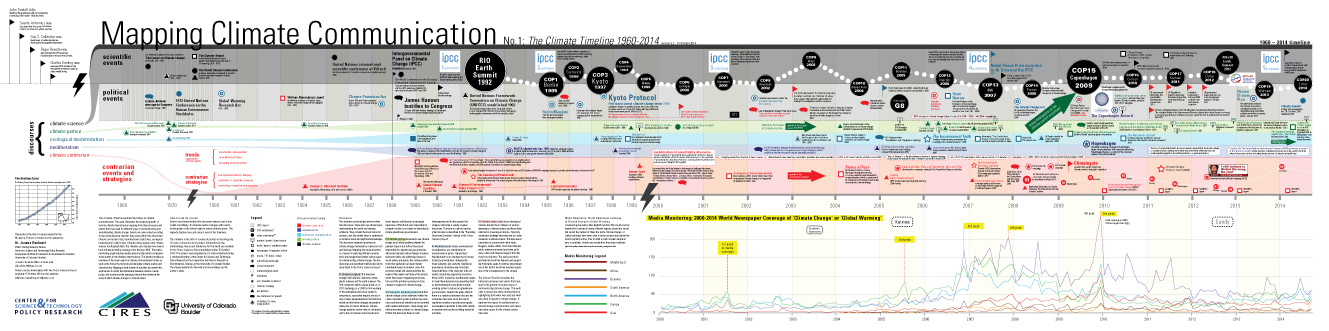
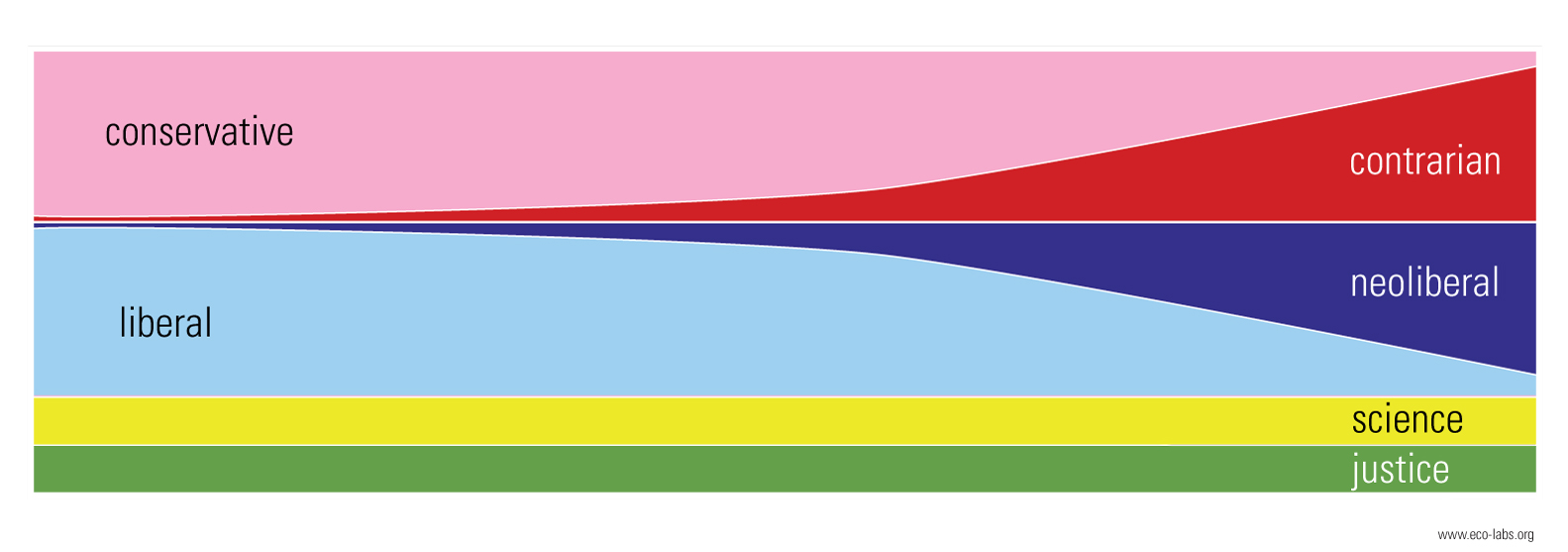
The Mapping Climate Communication project offers an overview of how climate change is communicated in the public realm by visualizing actors, events, strategies, media coverage and discourses influencing public opinion. Two large-scale maps and one Poster Summary Report were published on-line October 2014. The project uses two visualization methods: a timeline and a network visualization. The Climate Timeline (CT) visualizes the historical processes and events that have lead to the growth of various ways of communicating climate change. The Network of Actors (NoA) illustrates relationships between institutions, organizations and individuals participating in climate communication in Canada, United States and the United Kingdom. Together these two visualizations contextualize events and actors within five discourses: climate science, climate justice, ecological modernization, neoliberalism and climate contrarianism. Since communication happens at the level of rhetoric as well as the level of action, discourses in this project include explicit messages and also messages that are implicit within political, corporate and organizational activities and policy. This approach reveals tensions and contradictions in climate communication.

Design vs. the Design Industry

Design vs. The Design Industry

This article argues that designers are currently not able to effectively address contemporary environmental and social problems due to the systemic priorities of the design industry. Despite the fact that emergent cognitive and perceptual capacities enable a greater understanding of complexity and design practice evolves creating potential for social and technological innovation, the structural dynamics of the design industry reproduce conditions of deep unsustainability. In this article,“design” is theorized as the professional practice of creating new products, buildings, services, and communication. This is a broader practice than the work that is produced within the “design industry.” The design industry operates according to highly reductive feedback generated by capitalism that systemically ignores signals from the ecological and social systems. The exclusive focus on profit and quantitative economic growth results in distortions of knowledge and reason thereby undermining prospects for the design of long-term prosperity. Redirected design practice could be an antidote to this dilemma by transforming the system that determines what is designed. This article provides an overview of the political and economic dynamics that are relevant to designers concerned with sustainability.

Published in Design Philosophy Papers, Volume 12, Number 2, December 2014, pp. 119-136(18)

Ecological Perception: Seeing Systems – 2nd Paper for the DRS 2014

beware-fo-the-invisibilityImage-makers have the unique ability to make hidden ecological processes visible by revealing relationships, patterns and dynamics in complex socio-ecological systems. This paper describes how communication design can support relational perceptual practices and even nurture ecological perception. It presents specific methods to harness the latent potential of graphic design to communicate the context, causality and complexity of ecological processes and systems. Visual metaphors function to establish meaning. Furthermore, aesthetics experiences can provoke deep perceptual insights supporting new ways of perceiving our relationship to the environment. In these ways, graphic design has the potential to nurture the ability to ‘see systems’ – supporting both ecological perception and ecological literacy.

A second paper to be presented at Design Research Society’s conference DRS 2014. Download the paper here.

The Colorado Flood: On Risk + Climate – What we can learn from natural disasters.

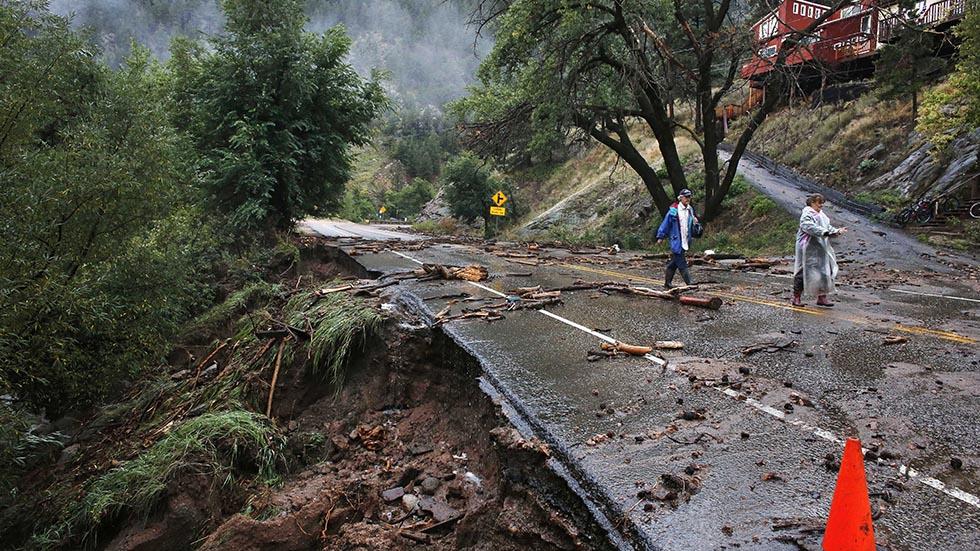
As some of the readers of this blog will know I recently moved from London to Nederland, Colorado (a small town outside of Boulder – where I work). I arrived just in time for the Colorado flood last week. My tiny home up at 8500ft elevation was undamaged, but the water ran down the canyon ripping up both roads and houses down stream in Boulder and beyond.

0f9e9f04-0955-4320-99ef-8b00b5e62904_980x551

Water from the mountains flowed down Boulder Creek at up to 25 times its normal intensity. The canyon road from Nederland into Boulder was badly damaged not only by mud and rockslides but by the erosion of its foundations as the earth dissolved into the river. Early this week I attended the town of Nederland post-flood recovery meeting where I witnessed the community coming to terms with the fact that the road we all depend on to get to Boulder has been partially washed away. Still we reminded ourselves that Nederland was lucky relative to many of our neighbours.

debc85fa-b1a1-424f-8d64-5c17a159c10b_980x551

Behind the statistics are thousands of stories and personal tragedies: 8 people killed, 11,750 people evacuated, 18,000 homes damaged, 1,600 homes destroyed, at least 30 bridges lost and an unknown quantity of roads and railway tracks severely damaged. Even more serious environmental disasters are in process as oil, gas and toxic fracking chemicals (including known carcinogens and endocrine disruptors) spills have become apparent at the site of at least 10 of the hundreds of fracking sites in the flood zone.

Continue reading

Confronting Despair in an Age of Denial – with Joanna Macy

jody15

This is a blog about strong emotions and how these impact our actions. I was inspired to write it by my encounter with ecopsychologist, Buddhist scholar and activist Joanna Macy – a woman who has pioneered working with despair since the 1970s. Despair in this blog will refer to a combination of feelings including grief, anger, powerlessness and fear. Continue reading

Re-Imaging the Commons as ‘The Green Economy’

The paper Re-Imaging the Commons as ‘The Green Economy’ was presented at the International Environmental Communication Association’s 2013 conference Environmental Communication: Participation Revisited: openings and closures for deliberations on the commons in June. This paper can be downloaded on www.academic.edu and on the EcoLabs website.

IECAbanner1

ABSTRACT: The United Nations’ green economy programme radically re-imagines the commons as a space where ecosystems services will be quantified, marketised and traded. This paper will examine issues with this version of the green economy for environmental communicators. It will review the etymology of the concept, examine contested ideas on what a green economy would entail and situate these proposals in relation to different economic approaches to the environment. It will suggest strategies for communicating the contested nature of the proposals and exposing obfuscations. This paper will argue that in stark opposition to green economics with its focus on participation and democratic processes, the UN’s GEP will close deliberations on the commons by privatizing ‘ecosystem services’ – thereby taking environmental decision-making out of a political sphere and into the marketplace.

The Green Economy (NOT!): The Final Frontier

Re-Imaging the Commons as ‘The Green Economy’ 

The United Nations Environment Programme’s (UNEP) (2011) flagship document titled “Towards a green economy: Pathways to sustainable development and poverty eradication” and accompanying UNEP reports at the Rio+20 in June 2012 launched the green economy project. The reports use strong environmental language as a means of presenting their version of green economy as a far-reaching programme of reform to address environmental problems on a global scale. While the rhetoric suggests that the UN is serious about addressing the biodiversity crisis, green economists and a wide variety of social movements are less convinced by the proposed policy mechanisms. Civil society responded at Rio+20 with a plethora of critical responses: condemning what they claimed amounted to the corporate capture of the United Nations (Joint Civil Society Statement, 2012); condemning the UN’s “Natural Capital Declaration” (Banktrack, 2012); condemning 20 years of Greenwash (Bruno, 2012); and indeed, condemning the entire green economy project (Nadal, 2012; Brand, 2012a; Patel & Crook, 2012). The Indigenous People’s Global Conference on Rio+20 and Mother Earth (2012) issued a strongly worded “Kari-Oca 2 Declaration” (2012) describing the UNEP’s green economy as “a continuation of colonialism” (p. 1) firmly rejecting market-based solutions, REDD, and intellectual property rights over genetic resources and traditional knowledge. In the wake of the polarized positions at Rio+20, the conference ended with both civil society and the United Nations unimpressed with the outcomes. The New York Times claimed Rio+20 “ended here as it began, under a shroud of withering criticism” (Romero & Broder, 2012); The Guardian’s headline read: “Rio+20 outcome a focal point for frustration among campaigners” (Ford, 2012); and London’s Financial Times announced “Rio+20 lacks ambition, says UN chief” (Clark, 2012). The conference failed to achieve binding targets, but more significantly the conference launched the UNEP’s green economy programme, which aims to redesign the processes through which the global commons will be managed. Clearly the green economy is a fiercely contested idea and the UNEP’s version is strongly opposed by a wide variety social movements concerned with both ecological conservation and environmental justice.

In naming its programme the green economy, the UNEP implies a reframing of the entire economy along green lines. The language even suggests a connection to a particular school of economic thought concerned with the environment, that of green economics. However, the programme itself is largely concerned with attempting to protect the environment by establishing policies that will quantify and trade “ecosystem services”. This will be done in ways that reflect specific policy prescriptions of different schools of economic thinking on the environment, namely environmental economics and ecological economics. Since green economics is a field with radically different policy prescriptions to what is proposed, the naming of the new project creates severe confusion with contested definitions of the “green economy”. In this paper, the UNEP’s green economy programme will be referred to as “UN’s GEP” to avoid confusion with what green economists have been describing as “green economics” for over a decade.

Continue reading

EcoLabs is moving!

Announcemnt2

In Colorado, I will be working on visualising issues of the green economy and climate communication discourses. This work would be situated in the Integrating Activities research theme at CIRES will focus on the visual communication of complex ecological problems. This practice-based research would facilitate interdisciplinary collaborations and learning thereby contributing to greater capacities to respond effectively to environmental problems.

Continue reading